As ludicrous as it may sound, I feel that my life has been one continuous series of events in which the long shot comes out ahead. As a child growing up in East LA in the 1960’s, the expectations for me were so low that had I been a practical, level-headed girl, I might easily have grown to fulfill them. Instead, I dared to dream big dreams. I dreamed that I would someday morph into a comic book style superhero who would defend my mother from my abusive father. I dreamed that I would be a rock star and change the world with my music and ideas. I dreamed that I would be a brain surgeon who would save lives with my brilliant mind.
I can almost hear the snickering from where I sit and it makes me smile, because who in their right mind wouldn’t laugh at those goals? But, as it turns out, I did grow into a strong woman who was able to stand up to my father on my mother’s behalf. I did help create an important rock movement that would make a lasting social and artistic impression on many people around the world. And, although I wouldn’t trust myself with a scalpel, I do think that my music, my writing and my ideas can cut and on more than a few occasions they’ve healed and possibly saved the lives of others who have struggled with similar difficulties.
Timing is everything, they say. My latest Women In Punk interview happens to come at a time when I have been re-examining the impact that individuals can make on the world around us. Can one person really change things for the better? Can one isolated incident affect a person in such a way that it literally alters the course of her life?
Allow me to introduce to you the truly talented woman named Killer. In 1978, Killer was relatively younger than most of the members of the original Hollywood punk scene, nevertheless she is a product of that scene. Those early days profoundly marked her, in particular the experience of listening to Carla Maddog play drums with the legendary early punk band, the Controllers. Killer's inspiring post-gig conversation with Carla Maddog would lead to her own career as a drummer and a punk ethic that would last throughout her life.
Killer went on to play in The Speed Queens and numerous other bands. As time passed, she fell off my radar until quite by accident I ran into her a few years ago at a Peaches show. Killer was her sound engineer. We spoke briefly and then fell out of touch again until a mutual friend led her to my website interviews. I was thrilled to reconnect with her and to find that she continues to blast through society's imposed limitations as fearlessly now as when she was a young teen.
Read Killer's Women in LA Punk Interview by clicking on the thumbnail below. Enjoy!
My dear old friend Ann Summa has recently released a book of her photographs and recollections of the LA punk scene between the formative years of 1978 to 1984. It's called The Beautiful and The Damned. It also includes photographs of many of the early punk groups that toured Los Angeles from other cities, including such under-acknowledged but hugely influential groups as The Slits (one of my personal favorites.)
Ann Summa and Kristine McKenna will be discussing the book and signing copies at Skylight Books on 11/14. I've been a fan of Ann's work for many years and have had the good fortune to be her subject on a number of occasions. To help get the word out about the book, Ann - in conjunction with KCET - will be giving away a free print of the Bags at the Hong Kong Cafe.
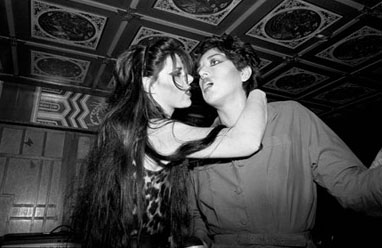
I'm not sure what's happening in this photo. Most likely I'm gasping for breath and Patricia is giving me a pep talk. I have included a link to the contest page below in case any of you want to enter.
I always thought of Arthur J and the Gold Cups as the Masque’s unofficial house band. The band was propelled by the riveting stage antics of Spazz Attack, famous for being able to do a flip through the air, completing a full 360 degree revolution in the middle of any given song. It was also endowed with the guitar virtuosity of Geza X, the steady beat of Brendan Mullen on drums and Hal Negro sending out elephant mating calls on his trumpet. The insanity and cacophony of their stage show teetered on the edge of dissonance and that is precisely where the sweet voices of the Cupcakes worked their magic on the band’s sound. In a stage show full of wild free-form musicianship the three pretty, unassuming backing vocalists, true to their name served up confections as pleasing to the eye as they were to the ears, providing a thread of melody on which the other band members performed their high wire acts of sound.
Christina Cupcake shares her memories of the Masque, Arthur J and her life with fellow musician Billy Bones of The Skulls in this latest Interview with Women in LA Punk. Read Christina's Women in LA Punk Interview and see more of her photos by clicking on the thumbnail below. Enjoy!
In the summer of 1978, The Bags had just finished playing a show at the Whisky when a skinny, bespectacled young man walked over to me and struck up a conversation. He was kind of nervous and after complimenting the band, he seemed to have run out of things to say. I was about to walk away when he impulsively pulled out a little book from a canvas satchel and thrust it towards me.
"Have you seen this?" he asked. It was Donna Santisi's book, Ask The Angels. On the cover was a beautiful photograph of Trudie Arguelles and Hellin Killer, looking like they'd just been kicked out of Heaven for making trouble. I was immediately captivated as each page treated me to photos of the people who were steering rock music in a new direction. What set Donna's book apart was that these were not the usual preening and posing rock gods featured in national music publications. Donna was chronicling the underground, rebels who were upsetting the apple cart of the music business.
I was so engrossed in the images that I almost forgot about the young man who had been looking over my shoulder. "Thank you for letting me see your book," I smiled at him.
"Keep it," he said, "if you like it that much, keep it." And I did.
32 years later, I am honored that Donna Santisi has agreed to answer my Women In LA Punk interview questions. I am also very happy to announce that her seminal punk photography collection, Ask The Angels, has just been republished in an expanded version with even more great photos. Congratulations, Donna!
Ask The Angels captures a very special moment in time for me personally, but it's just the tip of the iceberg as far as Donna's photographic career is concerned. I encourage you to check out her website at http://www.santisiphotography.com to see more of her amazing work. Those of you in the LA area have the opportunity to meet Donna personally and have her sign your copy of Ask The Angels on August 12th at Book Soup in West Hollywood. More details can be found here.
Read Donna's Women in LA Punk Interview and see more of her photos by clicking on the thumbnail below. Enjoy!
I first met Valiant in the late '70s, when she still went by the name of Heather. She was a creature of the night who dressed like a punk rock Coco Chanel. She had a film noir air of glamour which she cultivated with fascinators and cigarette holders. Her sense of style was so strong that I instantly trusted her when she invited me to sit in her salon chair.
Heather was just as comfortable in the Beverly Hills salon where she sometimes cut my hair as she was in her little apartment in Hollywood. We'd sip wine or tea while she chopped, colored and transformed my DIY locks into a cutting edge 'do. Sometimes we'd dress up and go out after my makeover, other times we'd grab a cheap bottle of wine at La Brea Circus and talk the night away sitting on her couch. In those days, Heather loved Sylvia Plath, romance, and red wine with nice labels. In fact, it was Heather who gave me my first lessons on selecting wine. First rule: look for a bottle with a cork instead of a screw top. I was still buying wine like a kid cutting class in high school, what did I know?
Click on the Women In L.A. Punk thumbnail to read her interview.
Angie and I slept like the dead in our room at the Hotel De Mendoza, located on the site of a former convent in Guadalajara’s Centro Historico. We made our way down to the hotel restaurant and feasted on their breakfast buffet which offered a mouthwatering spread ranging from pancakes to chilaquiles. The girls all woke up at different times (Angie and I being the early risers in the group), so we ended up eating and doing our sightseeing in shifts. This was a bit odd because although we would've preferred to go together, we had to settle for "Meet us at the Cathedral after breakfast," or "Meet us at the Museum." Eventually, we split up into small groups which worked out just fine.
My group headed over to the Parque de Agua Azul for a gigantic flea market that my new buddy Shizu Saldamando had told me about the night before. She described it as a "punk flea market" and I think the description was accurate. It wasn't like a big outdoor Hot Topic, it just seemed to have the sorts of things that we all liked: homemade silkscreened shirts, used and repurposed clothing, old comic books and records, handmade jewelry, lots of crafty items. Teresa Covarrubias and Lysa Flores bought beautiful necklaces, Colin Gunckel and I bought vintage comic books. Our friend Danny was turned away from making a purchase because his paper money looked “too thin.” "You look like a counterfeiter!" we laughed. It was such a big market that eventually we did get separated and by the time we finally reunited, it was late. The race was on to get back to the hotel and try to make it to soundcheck on time.
We drove up to the hotel where a mini bus was already waiting for us. We hadn't even paid for the cab before Judy Cocuzza started scolding us for being late (she is the most well-organized and responsible musician I've ever played with.) We ran up to get our stuff for the show, then burned rubber to the museum.
Outside the MUSA, a big stage had been set up for the Vexing performances. G, the head soundmeister, was unperturbed by our late arrival and quickly gave everyone the sound they wanted (thank you!) I was watching The Sirens soundcheck when I noticed the evening clouds had started to roll in, making the church behind the stage loom ominously like Dracula's castle.
Iphone photo by Alice Bag
Teresa, Angie, Patricia and I rushed off to the MUSA bathrooms to get gussied up for the show. I lined, shadowed and polished as best I could to try to make 50 look like 17, but I’m a musician, not a magician. I have to confess that in the restroom mirror I thought I looked pretty hot, unfortunately I couldn't see the bottom half of me and everyone was too nice to tell me that my clothes made me look lumpy. Oh well, I guess it's for the best, I couldn't very well have picked a new outfit from wardrobe.
The show started and The Sirens came out of the gates blazing! They played their hearts out and the audience ate it up. As I watched them, I knew I had to bring my "A" game because these ladies had set a very high standard for the evening’s performances.
Photo by Angie Skull
We were up next. Colin announced us and said lots of nice things. I was pleasantly surprised by the good quality of the monitor mix and pretty soon, Teresa and I were rocking out in tandem just as we had so many times before. Judy Cocuzza and Sharon Needles kept the rhythm solid and PK wailed on guitar. Lysa Flores joined us for Monedita de Oro and Angie Skull joined us for two songs: Modern Day Virgin Sacrifice (she was the sacrifice) and The Wolf. It was great being onstage with so many talented women. The audience was very warm and receptive, there were children and teens and middle aged folks all out for a night of free music and they liked us. At one point during our set, Colin Gunckel dove off the stage and started crowd surfing. It was sweet! We left the crowd wanting more, not to follow any old adage but because we didn't have any songs worked out for an encore.
Photo by Angie Skull
Lysa was up last, looking absolutely gorgeous in her little black ruffly dress. She was the perfect choice to close the evening. Lysa is a rose in full bloom; with her stage presence and musicianship at their peak, she easily made the audience swoon. At the beginning of her set, a mohawk wearing punk guy started to walk away, perhaps underestimating her edge but she won him over with her cover of Love Will Tear us Apart. He stayed next to the stage for the rest of the set, calling for an encore at the end.
The mood backstage after the show was electric. We packed up our stuff and got on the mini bus heading for Hotel De Mendoza, but we couldn't suppress our excitement and pretty soon an impromptu Vexing choir started singing and making up songs. When we ran out of invented songs, we followed up by singing Beatle songs.
Video courtesy of Danny Hound Dog.
After dinner at the hotel we cleaned up and went to the opening of 18 With A Bullet, an exhibit that Shizu Saldamando had invited us to. Shizu's work blows me away. I had seen her work in Vexing, Phantom Sightings and on the cover of the new Girl in a Coma album. Tonight, she was showing ballpoint pen ink drawings made on bed sheets and handkerchiefs. I asked her about the drawings and she made it sound easy, "Oh, I just put something firm underneath and draw while I'm watching TV" ...Genius! Really, she's a mega talent.
GrandStar, China Town, ball point pen on found bedsheet, 178x249 cm Shizu Saldamando. Photo courtesy of Shizu Saldamando.
The cherry on top of the evening was meeting some of the young punks who had seen our show earlier in the evening. Shizu had met them at the show and invited them to her opening. They brought gifts of CDs, stickers and postcards and thanked us for giving them a taste of 70's punk. It was wonderful to feel like we'd somehow inspired these young artists and I felt truly grateful to have been part of the whole event.
Here are the original interview questions and my responses:
-While looking at your website I saw a current photograph of you in Phoenix. Your face appears soft and characteristic of a time of peace. (cara lisa) How do your experiences as being part of the East LA Punk movement contribute to what you are doing today-musically, with your family life and other creative aspects?
Yes, I'm cara lisa as opposed to that scary, angry gorgon that I used to be in my punk days but you don't have to scratch the surface too hard before the gorgon reappears! I don't know if I can honestly say that I'm at peace. I think I have figured out a way to negotiate a truce which allows me to express myself in positive ways, or at the very least, to be less impulsive than I once was. I still have the capacity to rant and rave when I'm angry and I still consider myself fairly uncivilized, but with age and experience, I learned how to channel my energy in different ways. Peace is a big word, I can't isolate a few events in my life and say that I'm at peace when all around me the world is getting fucked by corporate interests and our country is waging war.
-How is East LA, as a community, responsible for the Punk movement that you were associated with in the l970's and 80's? Does the community still have a reservoir of creative energy for the current generation of musicians and artists?
My part in the ELA punk movement is really as someone who helped set the stage for what would transpire later. I was part of the Hollywood Punk Scene which was a well integrated scene that preceded the scene at the Vex. As part of that earlier scene, I, along with other Latinos was performing alongside other punk musicians in integrated bands. My band, The Bags, was one of those bands. I know that some of the younger kids who shared my gender, ethnicity or economic level were inspired and motivated by seeing a woman from a poor, working class family from East L.A. play and sell out the most popular clubs of the day. I wasn't singing about being a woman or about being poor or about being Latina: I was simply being who I was and singing about a broad range of topics.
By 1980 when the East L.A. scene at the Vex was going strong, The Bags had broken up and I was going back to school for my B.A. in Philosophy. I still attended and played shows infrequently but I didn't consider myself part of a scene at that time because my focus was elsewhere and to be part of a scene, I think you really have to be immersed in it. I played the Vex with The Castration Squad, an all female proto-goth ensemble and I also played with other groups. Although I was not immersed in the East L.A. punk scene, I was immersed in East L.A. I moved back to my parents' house in East Los and worked my way through Cal State L.A. by working at a Franco Florist in Montebello. I worked all day and practiced and played gigs at night.
I am traditionally associated with the Hollywood Scene that centered around the Masque and predates the opening of the Vex in 1980 by at least 3 years. East L.A. is where I was born, grew up and spent most of my life. My experiences there have shaped every aspect of my life. I was in my late 40's when I moved to the Westside of L.A., then to Phoenix, and now San Diego. Every community has a reservoir of creative energy. There is no ethnicity, gender or socio-economic group that has a monopoly on talent. The problem is that not everyone has the opportunity to make his/her voice heard and that the dominant culture controls the means of production, distribution and promotion and they select artists based on corporate goals rather than artistic ones. Of course, that has all changed radically thanks to punk rock's DIY ethic and the internet. There is a more level playing field today but it is by no means an equal playing field.
Hudley Flipside's interview came about completely by chance. My husband happened to notice a message on the Masque MySpace page that seemed to be directed to me. I should clarify that I have nothing to do with the MySpace Masque page. I conduct these interviews with women who were involved in the early LA Punk scene for my own website, but I haven't been in contact with most of the interview subjects in over 25 years and I don't usually try to track people down for interviews. They typically happen by chance, just like this one.
Hudley Flipside
Hudley's interview also differs from the norm in that she chose to completely disregard the question and answer format I sent to her. That's great, because I encourage all of my interview subjects to go off topic and write at length and Hudley took me at my word. Her expressed desire for total freedom is as close to the essence of what punk meant for many of us in the early L.A. scene.
Click on the Women In Punk thumbnail to read the interview with Hudley Flipside.