I feel fortunate to have been invited to several universities over the past two years where Violence
Girl - East LA Rage to Hollywood Stage, A Chicana Punk Story is being used in courses
with topics ranging from Literature to Music, to Chicano/a Studies, Gender Studies and beyond.
One question I am frequently asked is how I see my Chicana identity. It's a question that doesn't
lend itself to a short answer and I feel that it's important enough for me to take time explaining.
For as long as I can remember, I have been interested in social justice but I got off to a rocky
start on my road to forming a Chicana identity when I perceived negativity towards my odd,
unpolished glam-rock style from members of the Chicano organization at my high school. All
during my late teens and early twenties, I called myself a Mexican-American rather than a
Chicana because I believed that term was reserved for people in Chicano organizations like
MeCHa and I believed those organizations were biased against people who looked like weirdos.
Punk empowered me in all kinds of ways: it gave me the confidence to claim my Chicana
identity, to define it in my own terms and to refuse anyone the power to exclude me.
I never took any Chicano Studies classes until I was in college. My Chicana identity was formed
primarily from experiencing events where I felt that Mexicans and/or Mexican-Americans were
included and represented, events like the Chicano Moratorium which I attended as a child, the
grape boycott and the walk-outs at local schools in East L.A. These historic events all affected
me and made an impression on me. I was just a kid but I knew in a very simplistic way that it
was people like me standing up for people like me. I was attracted to the cause but I didn't feel
welcome in the club, so I have never been part of any Chicano organization but that doesn't
mean I'm not a Chicana.
I see my Chicana identity as a celebration of both my Mexican and American heritages as well
as an honest appraisal of the sociopolitical practices of these two societies and their influence
on Chican@ society. Both sides of my heritage have values and traditions which are beautiful
but sometimes flawed. Mexican and American societies are both guilty of sexism, classism,
racism, and homophobia and they both need fixing. I refuse to romanticize them or choose one
culture over another.
Ethnicity is not all that forges identity, my personal identity can stretch to be large and inclusive
or shrink to be small, focused and specific. In my broader identity I am a component and an
active member of the living organism that is the universe and in my smaller, more refined
identity, I function as a Chicana, feminist, bisexual, punk rocker. My personal identity is rich and
multifaceted - different aspects surface in different situations. When I'm discriminated against
as a woman, my feminist identity rushes to the forefront; when people try to negate the place
of Mexicans while teaching or discussing American history, the Chicana side of me will raise
an indignant voice and demand to be included and when anyone, anywhere in the world is
mistreated, the punk side of me that feels empowered to shape my world is ready to stand as an
ally.
Most of the time I'm just me: an individual, a human being only partially conscious of the ways
in which people see me or the expectations they might place upon this particular configuration
of atoms.
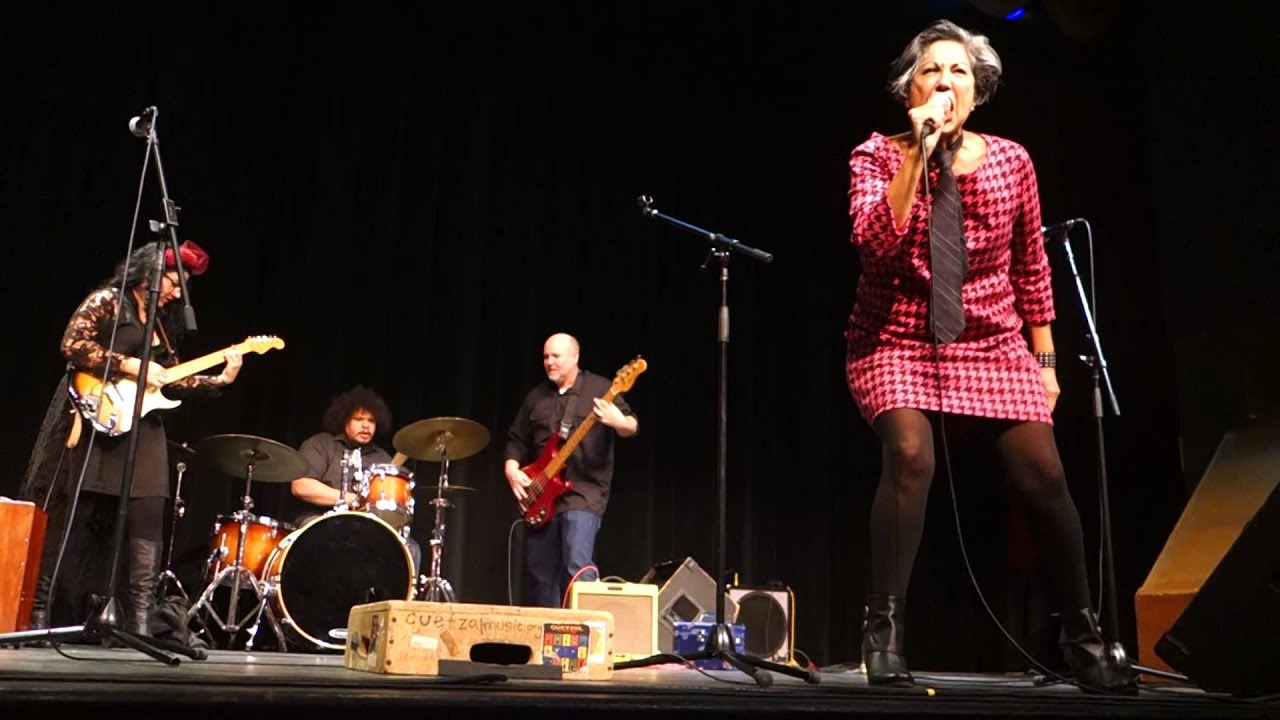
I see myself as limitless, so the labels are strictly to facilitate specific functions for a
limited amount of time.
When I first started performing, I remember looking out into the audience. Usually, there were
lights near the front of the stage illuminating me and the other band members. As my gaze
moved further back into the audience, the room darkened. I could make out the people in the
front rows clearly enough to read their faces and feel their energy but beyond that, the room
faded to infinite blackness and in my mind, that blackness might as well have been a view
of the vast reaches of the universe. From my perch on the stage, I felt incredibly powerful as
my performance elicited dancing, jumping and bursts of emotion from the concert goers. We
were exchanging energy, refueling, tapping into something much bigger than any one person.
I felt fully connected not just to the people in the room but to the entire universe.
Punk rock as
religious experience; go ahead and laugh, I know it sounds crazy. Connecting with others on
that level made me understand my power not just as an individual but as part of a community.
So while it's important to know who we are, it's also important to know that we are so much
more than labels can convey. We are conduits for ideas, we are agents of change.
Showing posts with label alice bag. Show all posts
Tuesday, March 04, 2014
Saturday, February 22, 2014
Little Seeds of Strength
My sister-in-law Mary passed away this week. I hadn't seen her in some time, since I moved out of state for several years. Still, the news of her death made me sad and I started to reflect on my memories of her.
Even though we didn't spend a lot of time together when I was growing up, my sister-in-law was a positive influence on me at an early age. She always spoke her mind and knew how to be assertive and self-possessed. On the few occasions when I was being bratty and insubordinate in her presence, she would wink at me conspiratorially, as if saying she understood how I felt. Other times she just laughed at me, at herself, at my father. She was good at laughing, at telling people what she thought, and best of all she was good at standing tall and filling a room with her presence. She was a strong woman who planted a little seed of strength in me at a time when I needed it most.
Oftentimes, we look to celebrities as role models but if we stop to look around, we can find people who provide everyday examples of strength and integrity. Mary was that for me. I will miss her.
Below is a chapter from my book, Violence Girl where I talk a little bit about her.
Friends and Baptisms
I wonder if I can find a way to blame my parents for my lack of friends. After all, my mom never had any friends. She kept busy by meddling in her children's lives, not that anyone ever complained. My mom was a sweetheart who would give you the clothes off her back if she thought you needed them. She liked nothing better than checking in on her kids to make sure we were doing well. My father had business friends but he only saw them when he was at work and he certainly never brought anyone over to our house. We were an isolated family unit.
My mother's meddling took a bold turn when my brother Raymond married a Protestant woman named Mary. When my mother found out that their child was not going to be baptized, she conjured a successful plot to kidnap the baby and baptize him in secret. Of course, the plot was later revealed and my brother and his wife were very upset that my mother hadn't respected their wishes. My mother was unrepentant, she insisted that she had to baptize the baby so that he wouldn't end up in Limbo, which is a place between Heaven and Hell where infants are trapped if they die in a state of original sin. In my mother's Catholic world, we are all born in a state of original sin, passed down to us from Adam and Eve's transgression in the Garden of Eden. The Catholic sacrament of baptism basically gives a clean slate to children who are too young to atone for their sins. My mom's description of Limbo made me imagine a place in the sky with millions of babies and toddlers crawling around on the tops of clouds, never knowing true happiness. I could see them standing on fat, wobbly baby legs holding onto the locked pearly gates, never able to enter the kingdom of Heaven. The thought made me sick. I wasn't disgusted by the babies or the parents who didn't have them baptized; I was disgusted that god wouldn't allow them into the kingdom of Heaven.
My brother and sister-in-law eventually got over my mother's kidnapping and started coming around again. I loved my sister-in-law Mary because she would talk back to my dad and she could hold her own in an argument. She never backed down. Their arguing made others uncomfortable but they seemed to enjoy their heated discussions. I liked to listen to them even though neither ever changed their point of view. It was fun witnessing their verbal sparring but I would later learn that engaging in passionate debates was not everyone's idea of fun.
My parents friends were all family. My brothers and sisters were all grown up and while my mother filled her days with housework, visits to the sobadora and finding ways to help her children, my father read incessantly and kept to himself.
My mom didn't have much faith in American doctors. Whenever she or any of her children got sick, she'd subject us to the ancient cures passed down by healers and sobadores. If I had a stomachache, out came the yerba buena or lemon grass tea. I didn't mind the minty taste of yerba buena or the subtle citrusy hint of flavor in lemon grass or the hot lemonade I had to drink if I was catching a cold but she had a large variety of other, more bitter herbs to choose from. Sometimes she'd come home with little brown bags of dried leaves that I was told would cure my ailment. From them, she would concoct vile tasting medicinal drinks whose chief benefit was that they would induce nausea and vomiting.
I used to make fun of my mother for favoring what I considered to be superstitious folk cures. It didn't boost my confidence when she'd pass an egg or a tomato over someone with a fever so that the foods would draw off some of the heat from the afflicted or that she'd frequent a sobador, a sort of massage therapist whose brusque jerking and tugging could untangle your intestines or align your body for maximum health. Often, these cures were combined with prayer, incense, candles or oils. I called her methods brujeria (witchcraft) which made her pretty angry but she suffered my ignorance. I thought myself so much smarter than her; it was only much later that I would come around to questioning the supremacy of western medicine and admit that maybe my mom's herbal cures and aromatherapy were helpful.
Not all her beliefs grew on me though. I had been raised as a Catholic but as I said before, my mother's brand of Catholicism incorporated elements of Mexican folk beliefs and superstition. On previous trips to Mexico, I had seen people walking on bloody knees, making their way up to the Basilica de Guadalupe to pay off a debt to La Virgen. My own aunt told me that she had promised god to make the journey from her house to the Basilica on her knees when one of her kids was sick. Her faith impressed me but the logic of it all eluded me. My mother told me stories of people she knew who had spent their childhood dressed in a Saint's vestments as a sort of payment for the saint's intervention. Still others were known to place a statue of San Martin de Porres in a headstand position until the saint would find them a suitor. The idea of bargaining with god or holding a saint hostage made no sense to me at all and doubt chipped away at my religious beliefs.
I identified more with my father than with my mom. I too enjoyed reading incessantly and I was comfortable being alone most of the time. At our Bonnie Beach house we had a proper dining table and although we rarely ate meals together, when we did, my dad and I just ignored each other and read our own books while eating. My father read his life away. He always had his paperback westerns with him in the car, the bathroom, at the dinner table, even while watching TV he'd shift back and forth between the screen and his book. My mother never ate with us, she was always busy warming up tortillas or doing something else in the kitchen.
I used to watch Leave It To Beaver and there was a part of me that longed to be like the Cleaver Family, who sat around eating meals together, discussing the day's events. June Cleaver would never kidnap a baby, put a tomato on Beaver's forehead if he had a fever or spend all her time in the kitchen warming tortillas. I bet Beaver would have turned out much differently if she had.
Even though we didn't spend a lot of time together when I was growing up, my sister-in-law was a positive influence on me at an early age. She always spoke her mind and knew how to be assertive and self-possessed. On the few occasions when I was being bratty and insubordinate in her presence, she would wink at me conspiratorially, as if saying she understood how I felt. Other times she just laughed at me, at herself, at my father. She was good at laughing, at telling people what she thought, and best of all she was good at standing tall and filling a room with her presence. She was a strong woman who planted a little seed of strength in me at a time when I needed it most.
Oftentimes, we look to celebrities as role models but if we stop to look around, we can find people who provide everyday examples of strength and integrity. Mary was that for me. I will miss her.
Below is a chapter from my book, Violence Girl where I talk a little bit about her.
Mary and her son Charlie, June 1967
Friends and Baptisms
I wonder if I can find a way to blame my parents for my lack of friends. After all, my mom never had any friends. She kept busy by meddling in her children's lives, not that anyone ever complained. My mom was a sweetheart who would give you the clothes off her back if she thought you needed them. She liked nothing better than checking in on her kids to make sure we were doing well. My father had business friends but he only saw them when he was at work and he certainly never brought anyone over to our house. We were an isolated family unit.
My mother's meddling took a bold turn when my brother Raymond married a Protestant woman named Mary. When my mother found out that their child was not going to be baptized, she conjured a successful plot to kidnap the baby and baptize him in secret. Of course, the plot was later revealed and my brother and his wife were very upset that my mother hadn't respected their wishes. My mother was unrepentant, she insisted that she had to baptize the baby so that he wouldn't end up in Limbo, which is a place between Heaven and Hell where infants are trapped if they die in a state of original sin. In my mother's Catholic world, we are all born in a state of original sin, passed down to us from Adam and Eve's transgression in the Garden of Eden. The Catholic sacrament of baptism basically gives a clean slate to children who are too young to atone for their sins. My mom's description of Limbo made me imagine a place in the sky with millions of babies and toddlers crawling around on the tops of clouds, never knowing true happiness. I could see them standing on fat, wobbly baby legs holding onto the locked pearly gates, never able to enter the kingdom of Heaven. The thought made me sick. I wasn't disgusted by the babies or the parents who didn't have them baptized; I was disgusted that god wouldn't allow them into the kingdom of Heaven.
My brother and sister-in-law eventually got over my mother's kidnapping and started coming around again. I loved my sister-in-law Mary because she would talk back to my dad and she could hold her own in an argument. She never backed down. Their arguing made others uncomfortable but they seemed to enjoy their heated discussions. I liked to listen to them even though neither ever changed their point of view. It was fun witnessing their verbal sparring but I would later learn that engaging in passionate debates was not everyone's idea of fun.
My parents friends were all family. My brothers and sisters were all grown up and while my mother filled her days with housework, visits to the sobadora and finding ways to help her children, my father read incessantly and kept to himself.
My mom didn't have much faith in American doctors. Whenever she or any of her children got sick, she'd subject us to the ancient cures passed down by healers and sobadores. If I had a stomachache, out came the yerba buena or lemon grass tea. I didn't mind the minty taste of yerba buena or the subtle citrusy hint of flavor in lemon grass or the hot lemonade I had to drink if I was catching a cold but she had a large variety of other, more bitter herbs to choose from. Sometimes she'd come home with little brown bags of dried leaves that I was told would cure my ailment. From them, she would concoct vile tasting medicinal drinks whose chief benefit was that they would induce nausea and vomiting.
I used to make fun of my mother for favoring what I considered to be superstitious folk cures. It didn't boost my confidence when she'd pass an egg or a tomato over someone with a fever so that the foods would draw off some of the heat from the afflicted or that she'd frequent a sobador, a sort of massage therapist whose brusque jerking and tugging could untangle your intestines or align your body for maximum health. Often, these cures were combined with prayer, incense, candles or oils. I called her methods brujeria (witchcraft) which made her pretty angry but she suffered my ignorance. I thought myself so much smarter than her; it was only much later that I would come around to questioning the supremacy of western medicine and admit that maybe my mom's herbal cures and aromatherapy were helpful.
Not all her beliefs grew on me though. I had been raised as a Catholic but as I said before, my mother's brand of Catholicism incorporated elements of Mexican folk beliefs and superstition. On previous trips to Mexico, I had seen people walking on bloody knees, making their way up to the Basilica de Guadalupe to pay off a debt to La Virgen. My own aunt told me that she had promised god to make the journey from her house to the Basilica on her knees when one of her kids was sick. Her faith impressed me but the logic of it all eluded me. My mother told me stories of people she knew who had spent their childhood dressed in a Saint's vestments as a sort of payment for the saint's intervention. Still others were known to place a statue of San Martin de Porres in a headstand position until the saint would find them a suitor. The idea of bargaining with god or holding a saint hostage made no sense to me at all and doubt chipped away at my religious beliefs.
I identified more with my father than with my mom. I too enjoyed reading incessantly and I was comfortable being alone most of the time. At our Bonnie Beach house we had a proper dining table and although we rarely ate meals together, when we did, my dad and I just ignored each other and read our own books while eating. My father read his life away. He always had his paperback westerns with him in the car, the bathroom, at the dinner table, even while watching TV he'd shift back and forth between the screen and his book. My mother never ate with us, she was always busy warming up tortillas or doing something else in the kitchen.
I used to watch Leave It To Beaver and there was a part of me that longed to be like the Cleaver Family, who sat around eating meals together, discussing the day's events. June Cleaver would never kidnap a baby, put a tomato on Beaver's forehead if he had a fever or spend all her time in the kitchen warming tortillas. I bet Beaver would have turned out much differently if she had.
Labels:
alice bag,
catholicism,
family,
feminism,
role models,
strength,
Violence Girl
Tuesday, December 03, 2013
Remembering Clifton's Cafeteria
Q: You briefly mention Clifton's Cafeteria in your book, Violence Girl. I've heard other interviews with you where you go into more detail about this unique place of LA's restaurant history. Why didn't you write more about it in your memoir?
Alice: I actually thought I wrote much more about Clifton's. It's possible that I did in an early draft, but I had to cut out some scenes that didn't advance the overall story. It may have ended up as a deleted scene.
Q: Why was Clifton's so memorable for you as child?
Alice: It was a total sensory experience. For me, atmosphere is really important in a restaurant. Clifton's definitely had atmosphere. You could tell you were getting close because you could hear the tambourines going and the preaching and singing. The "Hallelujahs" were out front preaching The Word. I was a little kid. I thought they were there to entertain the customers going into Clifton's. My parents just wanted to get through them and not have to give them any money.
Q: Describe the interior of Clifton's for us.
Alice: It had a forest theme with lots of trees, taxidermied woodland creatures, bears, giant boulders. I think it was four floors. You walked in on the ground level and there were curved staircases leading up on either side to different dining terraces. Each of the rooms was decorated differently. My favorite room was at the very top. I think it was called the Red Room because it had red painted walls, flocked red wallpaper and red carpet. I thought it was very elegant. Come to think of it, I have used the same deep red color in my own house for years now. My daughter calls it the "Welcome to Hell" look.
Q: So what did you like to eat at Clifton's?
Alice: Well, it was kind of tricky because of the cafeteria style. If you walked by and picked up the first tasty thing you saw, the dishes would accumulate. You wanted to take the tasty thing, but if you took it too early, you would load up before you got to the main courses. I tried to get either mashed potatoes, or the mac and cheese. Not both (laughs). Although I wanted both. I would usually get peas, although I also liked the carrot raisin salad. Really good...and then they had Waldorf Salad too, that was really good. And it sounded fancy cause it was from The Waldorf. My main course was always Salisbury Steak!
Q: Salisbury Steak? Isn't that just a hamburger patty with gravy?
Alice: No, Salisbury Steak is made from wild, organic Salisbury. Free Range Salisbury Steak - it's really good. You should try it sometime. I think they carry it at Whole Foods.
Labels:
alice bag,
Clifton's Cafeteria,
DTLA,
Los Angeles,
Restaurants,
Violence Girl
Tuesday, September 10, 2013
Angel Baby
My half sister Yolanda was 10 years old when I was born, so I literally and figuratively looked up to her. I remember her teaching me how to do the Twist. When my mom wasn’t home, I could always count on Yolanda to boss me around. I didn’t mind. She didn’t yell like my father was prone to do, and she didn’t talk to me like I was simple, which my mother tended to do. My sister always took the time to explain things to me, at times seeming wiser than either of my parents.
In my eyes, Yolanda was the most beautiful girl in the world (not counting Sarita Montiel, who I considered the most beautiful woman in the world). When I was a little older and we moved to the Ditman house, my dad and I would watch beauty pageants together on TV. We’d take a pencil and paper and score the contestants. We’d see who could pick the most winners after each elimination round. Once, my sister walked into the living room while we were doing this, and I remember looking at her and thinking she could beat them all. After that, I hounded her for weeks, begging her to enter a beauty pageant. I could imagine my sister on TV, having a crown placed on her head and having a big bouquet of roses handed to her. She’d smile at us through the television screen and I would be jumping on the couch with joy! I was sure she’d be a winner, but my sister dismissed my pleas with a flattered giggle, and eventually I gave up.
My sister was the only other person besides my mother and I to experience my father’s rage on an ongoing basis, and when I think about it now, it must have been harder for her to bear than it was for me, because he wasn’t even her natural father. He was just some random ogre who beat up her mom. My sister and father rarely spoke to each other except in the most cursory manner. Yolanda had lost her real father to cancer at a young age. It would have been nice if my dad could have given her a father’s love, but I don’t think she wanted it from him. I suspect that Yolanda deliberately tried to make herself invisible when my dad was around. Whenever possible, my sister stayed out of the house.
When we moved to Ditman Avenue, my sister Yolanda entered Stevenson Junior High School and met Angel Lujan, with whom she would eventually get married and spend the rest of her life. Yolanda spent most of her time after school at Angel’s house. When she and Angel did come to our house, they could usually be found making out in the narrow space between the neighboring apartment buildings. Being a typical little sister, I’d sometimes spy on them and throw rocks at them, and Yolanda would toss back empty threats at me. It seemed like Yolanda had managed to find a little piece of happiness and a way to save herself from the ugliness that thrived in our home. I don’t blame her for moving away from home at the first opportunity.
Yolanda died of cancer a few years ago. Being at my big sister’s side during the last few weeks as she struggled to fight off the inevitable was heartbreaking, because she was in excruciating pain. The type of cancer she had was incurable, and the doctors sent her home to live out her final days with her family. All we could do was try to dull her pain with morphine, but on the day she was sent home from the hospital, the nurse practitioner was delayed in getting to her house, and Yolanda began to moan for help as the drugs wore off. Panicked, Angel and I tried to figure out how to ease her suffering. I thought seriously of calling a friend who might have access to heroin. Finally, the drugs arrived and Angel, unable to see clearly through his grief, asked me to administer the painkiller into her mouth. “You can’t give her too much,” he said to me, but he needn’t have, since we were both thinking the same thing. Yolanda was in so much pain by then that all I could think to do was to help her by ending it. Every time she awoke and cried out in pain, I gave her more morphine to ease her suffering. In the end, I honestly think I may have taken my sister’s life by overdosing her on painkillers.
I dedicate this version of Angel Baby to my beloved older sister, Yolanda. This song will always remind me of you, sis.
Labels:
alice bag,
angel baby,
cancer,
east la,
family,
Los Angeles,
sisters,
Violence Girl
Thursday, August 01, 2013
On Writing Violence Girl, DIY, Community and Creativity
Interview with Alice Bag, July 2013
(this is part of a larger project examining the intersections of feminism, creative writing, and punk)
Reposted with permission from http://heyitsunclefranklin.tumblr.com
***********************
Your writing has taken many forms — lyrics, blogs, and now memoir with the publication of Violence Girl: East L.A. Rage to Hollywood Stage, a Chicana Punk Story. What inspired you to write the book?
A friend of mine was interviewing me for a play she was writing about East LA. We were at a bar, swapping stories about growing up on the east side during the 60s and 70s. We were all laughing when she turned to me and said “you should write a book." Her words stuck with me.
The next day when my husband went to work, I found the laptop left open to a new webpage he had created for me. It was a blog site called “The True Life Adventure of Violence Girl." I’m a comic book and graphic novel fan so I especially loved the ring of “True Life Adventures." I got sucked in and started writing: an entry a day, every weekday. Over the course of the next ten months, I wrote what would become my memoir, Violence Girl.
What influence have DIY ethics had on your motivation to write?
At the point in my life when I started writing Violence Girl, I didn’t even see myself as a real writer. I was blogging regularly at the time but I couldn’t imagine writing a whole book. Blogging is a manageable commitment, you don’t need a lot of time or planning to do it and it’s very DIY; anyone can write and share their thoughts and feelings with the world. You don’t need to major in journalism to have a successful blog, you just have to have something interesting to say and figure out a compelling way to say it.
The idea that you don’t need to master a technique in order to create something meaningful or useful is the essence of DIY (and punk) to me. I often joke that I wrote my book using the punk rock method: short, fast stories, hammered out with more honesty than ability. It worked for me, and I think readers who connect with my book are willing to look beyond my writing limitations.
My roots are in performance, and I think it’s important to note that having an audience or a community to provide encouragement and feedback during the writing process really helped me. When I was blogging “True Life Adventures of Violence Girl," I picked up followers along the way to whom I felt connected. They gave me daily feedback and encouragement on each new installment, they even pointed me towards potential publishers when I finally finished writing my story. I felt like I had a community behind me who wanted to see the book published.
You’ve talked about the importance of documenting the creative output of social and art movements. How does the desire to create recorded history inform your writing?
Writing the book was something that I really did for myself. I didn’t approach it as a documentarian, it was more a journey of self-discovery and healing. As I was writing about my childhood I realized that for those I love to really know who I am, they have to understand what shaped me. After a while, I realized that other people might be facing some of the challenges that I faced while growing up and might benefit from reading my story, so those are the things that informed my writing. There is certainly a historical element to the book, not so much about the creative output of any particular artist but about what environmental conditions led up to punk and fostered the movement’s growth. I consciously avoided the documentary approach towards the LA punk scene because other books have already taken that approach and I wanted to tell a much more personal story, one I hoped would be more universal and not just of interest to punk fans.
What role do you feel the presence of community — be it through punk, one’s cultural identity, etc. — plays in fostering creative development?
It’s huge! As I mentioned earlier, I felt like my community of blog followers really carried me. They encouraged me every step of the way. When I didn’t feel like writing and would skip a day, they gently reminded me that they were waiting for my next blog entry!
Community, especially the community I built through social media, also played a big part in the success of my book tour. I booked my own tour - it was all DIY, cold calling places or getting suggestions from Twitter and Facebook friends. If friends were currency I would be a millionaire. I had so much help from people across the country who helped book readings, offered to play with me or offered me a place to sleep. My publisher is a small publisher and does not offer tour support so it was all DIY, punk rock style. Hugely rewarding, especially for an old bag in her mid-fifties; it felt like the fucking fountain of youth to be on the road, playing, reading, meeting new people and it would not have happened without my communities supporting me every step of the way.
In Violence Girl, you connect the trauma of abuse to your involvement in the punk scene. How do you feel punk can act as a site for meaningful catharsis?
Sometimes you just can’t verbalize what you’re feeling because you may not even be consciously aware of what’s triggering your emotions. When I was younger, I didn’t understand where my feelings of anger and violence were coming from and I didn’t know how to deal with them. Luckily, punk came along and gave me an outlet. Through punk performance, I could vent and forge the raw emotion that was bubbling up inside of me into something creative rather than destructive.
Beyond that, I think punk is really empowering in the long term because it encourages self-determination and challenges the status quo. As part of the punk community, I came away with the feeling that if we were able to create a movement that continually changes the course of art and music, then we can create a movement that changes the world in many other ways. That is enormously empowering.
How has your relationship to creative expression changed over the years?
I still tap into my anger from time to time but these days, I usually know where it’s coming from. Over the years, I’ve realized that the only limits to my creativity are the ones I place on myself by saying “I can’t do that, because…" There really aren’t any limits when we stop making excuses for why we can’t do something. I think I’m much braver as an artist now than I was 35 years ago and I’ve learned to value the ups and downs of getting where I want to go because the only failure is not to go after your dreams.
Labels:
abuse,
alice bag,
community,
creative expression,
DIY,
performance,
punk,
recovery,
Violence Girl,
writing
Thursday, February 21, 2013
Rolling Crones and Old Bags
It's been a few days since the L.A. Zine Fest and the panel discussion I did with Allison Wolfe and Drew Denny, but I'm still feeling a little giddy about the whole thing. A big part of the fun was having the opportunity to meet these ladies I'd never met before and collaborate with them, even if it was only briefly and on just one song. It was still meaningful and memorable for me. It's always exciting and rejuvenating to work with new people who have fresh ideas and approach creativity from a different perspective, and it's especially thrilling if the new people happen to be smart and talented women.
After reflecting on the experience, I realize that there are a few points I'd like to clarify. During the introduction, the moderator (who did an absolutely wonderful job, by the way) described Allison Wolfe as one of the mothers of the Riot Grrl movement, then started to introduce me in a similar fashion as one of the 'mothers of punk' but stopped herself, perhaps noticing the age difference between me and Allison. She suggested that maybe she should say a 'grandmother of punk,' but I objected. I want to clarify why I object to that label. It's not because of age. I'm 54 years old, I have gray hair and I'm comfortable with my age. I am perfectly happy if you call me a punk rock vieja, an old bag, or a crone (I even wanted to form a band or have a mentoring program for and by older female musicians called 'The Rolling Crones' at one point) but I object to being called a grandmother because I'm not a grandmother.
I have three daughters who are all in school. They're all young women who are very responsible, they behave in a way that I am very proud of, they've taken charge of their sexuality and the fact that they're not mothers is something that I'm happy about. My daughters have chosen to put their studies first at this point in their lives and they're waiting to have children until they're ready. They are exercising their choice, a choice that many of us have been fighting for years to be able to offer them. Another thing is that when I was young, it was quite common for relatives to harass young women about when we would get married and have children. I don't ever want my daughters to feel that pressure. They can marry or stay single for as long as they want, they can have children, adopt, or do neither. And for those reasons I ask you to please feel free to call me old, but please don't call me a granny.
By the way, I want to reiterate that I think K did a great job as moderator and this is in no way meant as a criticism of her!
Another point that needs clarification is that a recent article mentions that when I was in the Bags, I wore a paper bag on my head to escape stereotypes. This is only slightly different from what I said, but it's a significant difference because it deals with intention. In my early L.A. punk band, the Bags, we wore paper bags on our heads primarily for fun, to hide our identities and challenge the audience. They were not worn in a conscious attempt to avoid stereotypes, although that was an unintentional bonus. Creating the bag characters forced our audiences to focus on the music, the bag masks, the performance. We felt like we went in with a clean slate. People didn't know what to expect from us and that was fun and liberating. We also had punk names which were associated with our band; this was something we borrowed from the Ramones. Having a band last name also blurred ethnic identities. Torn thrift store clothing and safety pins were worn by rich and poor alike, further helping to blur class distinctions. Finally, the music was raw and unpolished, which opened the door for many novice musicians.
Part of what made the LA. scene so diverse and open to new ideas was that we focused on what we had in common: the creativity, the desire for innovation. That isn't to say that we didn't value our backgrounds or that we tried to hide them - we did not. We approached our creative community as individuals who didn't feel valued by the mainstream, in many cases we didn't even feel at home in our own hometowns, where many of us were seen as weirdos. We found our tribe in the punk community who valued originality.
During those early years, that was what suited me. Later, I found that in order to continue to fuel my personal growth and creativity, I wanted to dig deeper into my heritage and identity. Other elements of my personal story started to surface in my work and I think I've become a better artist and a more effective communicator because of it.
But I don't want to babble, babble on. Back to the panel. I found the conversation about how each of us had dealt with gropers in the past enlightening. Allison told a story of having a male audience member cup her butt during a performance, only to have the dude checked by the mostly female audience members at her show. I punched a guy who grabbed my crotch. Unfortunately for him, he happened to be wearing glasses that shattered under my fist and sliced his face open. Drew said she tried to deal with sexual intimidation with a sense of humor. I found her reply a little scary but after she explained it, I could see that what she meant is that the ultimate goal of gropers is to intimidate and her approach was to turn the tables. She said she knew it was not for everyone, but I think I'll try it. I'll see if I can come up with a joke while they're taking the groper out on a stretcher!
Labels:
alice bag,
allison wolfe,
drew denny,
feminism,
la zine fest
Location:
Los Angeles, CA, USA
Wednesday, October 17, 2012
Moonage Daydream
I had been rehearsing for my upcoming shows in California when I decided to take a little break from my planned set and Moonage Daydream popped into my head, so I decided to record it for you. Here is the little story about how I got to audition for Kim Fowley from my book, Violence Girl. It goes with the song at the bottom of this post.
“I got your number from Rodney Bingenheimer,” the man on the phone began, my ears perking up immediately upon hearing Rodney’s name. “We are holding auditions for an all-girl group, and Rodney told me about your group.”
Yes! Oh Rodney, you wonderful man, you remembered me!
The man was still talking. There was something irritating about his voice; he was not as pleasant or warm as Rodney. I met his gruffness with my own. “Excuse me,” I interrupted. “Who are you?”
“My name is Kim Fowley, I’m a record producer.” I knew who he was. We hadn’t been listening to that Runaways record without doing a little research on them. Fowley was credited with not only helping to assemble the band and co-write the songs but with being a strong force in shaping and promoting
them. He started listing his accomplishments, and I assured him I knew who he was.
“So are you looking for an all-girl band?” I asked, getting a little nervous now that I knew who was on the other side of the phone.
“Not exactly... I’m looking to assemble an all-girl band, similar to the Runaways, and I want to invite you and your band members to the audition.” That didn’t sound as good as I’d hoped, because all of us would have to audition separately. “Rodney tells me you’re a singer,” he continued.
“Yes.”
“Can you sing something for me now?”
Now? Damn it, I had just woken up and I was caught off guard. “What do you want me to sing?”
“Sing whatever you want,” Kim told me. I drew a blank. Which songs did I know the words to?
“I’m an alligator…” the song came out of my mouth before I had a chance to weigh my options. I sang halfway through David Bowie’s “Moonage Daydream” before Kim stopped me.
“That’s fine,” he said. “Come on down to the auditions so that I can see what you look like, and bring the other girls."
Monday, July 02, 2012
Alice Bag Olympia Power and Light Interview
This article originally appeared in an abbreviated version in the Olympia Power and Light in October, 2011. This is a repost of the full interview, which appears here.
All B/W photos by Louis Jacinto.
Tuck Petertil: It seems that we live in interesting times, as the economy buckles and fascism is on the rise, are you an optimist or a pessimist about the future?
Alice: I am extremely optimistic. I’ve been following the protestors who are occupying Wall Street and I have a renewed faith in democracy. Americans have been complacent for a long time because a large number of us were comfortable. It wasn’t until huge numbers of people starting losing their jobs and homes that reality started to break through their placid stupor. Those people camping out at Liberty Square, they’re the true champions of democracy. I think the protests will continue to grow.
Tuck: Do you have advice to young people facing this uncertain future?
Alice: Uncertainty doesn’t have to be scary, it’s all a matter perception and adaptability. If your plans don’t work out, it isn’t necessarily a bad thing. The unknown can be exciting and full of opportunity but you have to be involved and you have to be able to evolve.
Tuck: I’ve only read excerpts of “Violence Girl”, but it’s an impressive life you’ve led. Up here in the Pacific NW we’re just entering the fall and winter months, a time that can be pretty depressing. No doubt you faced many obstacles in your life, what gave you the strength to keep on in the face of opposition?
Alice: If I lived in the Pacific NW full spectrum lighting would be my first investment. My body needs sunlight. When I was little my dad used to tell me, “You can be anything you want to be.” I believed him. Even when I learned that society expects very little from a poor girl from East L.A., I refused to accept the limits that other people tried to place on me. It’s not that I don’t have weaknesses. I’m better at some things than I am at others but I never let insecurity stop me from doing what I want do. I am not a perfectionist, I believe that my best is good enough. If you believe that your best is good enough, you will find happiness.
Tuck: How did The Bags all hook-up? Who was in the Bags and where are they now?
Alice: My friend Patricia and I wanted to have an all girl band when we were in high school but our efforts were constantly thwarted because at that time, there weren’t as many women musicians as there are today. We put an ad in the paper seeking female musicians and men answered. Eventually we ended up hiring guys to play with us. We decided to play while wearing brown paper market bags on our heads with the eyes, nose and mouth cut out. The bag masks were just for fun, they gave us a certain anonymity that was somewhat liberating. We also had the opportunity to decorate our masks in ways that helped us play with our stage personas. The first Bags lineup was Patricia Rainone (Morrison/Vanian), Geza X, Joe Nanini, Janet Koontz and me. Patricia is now married to Dave Vanian and lives in England, Geza X is a record producer, I have lost touch with Janet over the years so I don’t know what she is up to, Joe Nanini went on to Wall of Voodoo and later passed away and I live in Sedona with my husband and daughter. The Bags had a rotating lineup of musicians but the one most people know from our Dangerhouse record is Patricia, Craig Lee (RIP), Rob Ritter (RIP), Terry Graham (later with Gun Club) and me.
Tuck: What were some of your influences (literary, music etc..) that put you on the path you choose?
Alice: when I was very young my dad listened to a lot of Mexican music, specifically rancheras. My sister listened to soul music. Those two genres seeped into my blood. I have a deep connection to that music. Later, when I was a teen I started listening to glam/glitter rock, Bowie, Elton John, Roxy Music, Queen, stuff like that. Suddenly out of nowhere the Ramones appeared. The Ramones were in a class by themselves. When they came out people laughed at them. Rock with no solos, imagine that! But their influence was huge and Patti Smith, wow, she was the most amazing performer, she inspired me tremendously! As for literature I grew up with comic books: Hot Stuff, The Archies, Little Lotta, Richie Rich, Mexican comics and fotonovelas. I go to the library at least once a week, I have for years. I am not a picky reader but I do get in my moods where I favor one type of book over another. I’m a big fan of Dickens, Bukowski and I adore Ozamu Tezuka. There are too many wonderful authors for me to list here but I have a Goodreads account for anyone who wants to compare books with me.
Tuck: What music are you currently liking?
Alice: I like Girl in a Coma, Amanda Palmer (with or without the Dresden Dolls), Gossip, Lysa Flores and I enjoy watching Lady Gaga’s many transformations.
Tuck: Besides your new book and your great website and blog, what other cool things are going on in Alice Bag's world?
Alice: I’ve been keeping up with the exploits of Anonymous, I like their spirit! If you visited my world there would be lots of pastries there. I love to bake, I’m trying to master the French macaron but I can’t get the texture just right. I took a pastry series at a local culinary school and I don’t want to forget what I learned so I bake every chance I get.
Tuck: Have you been to Olympia before? If so any thoughts about our town? Where does this tour take you?
Alice: I have never been to Olympia. I love experiencing new places so I’m really looking forward to it! I am still booking the tour so I don’t know where I’ll end up. Hopefully Olympians will like me and invite me back. I’ve never been to Canada, I wouldn’t mind going to Vancouver next time I’m in the neighborhood.
Tuck: Tell me about your future plans; i.e. Any new recordings or books in the offing?
Alice: Artifix Records is planning to release a limited edition promotional EP to coincide with Violence Girl. It features one Bags song as well as a small sampling of some of my other bands, from Las Tres to Castration Squad and Cholita. My only plans right now are to promote the book and to enjoy the journey. I have to balance that with making time to nurture my family and my relationships, while at the same time keeping an eye on my government to make sure they start paying attention to my welfare instead of protecting corporate interests. Oh, and I have to work on my French Macaron! That’s all.
Tuck: Would you like to tell one story about the punk scene or Managua?
Alice: How about a page from my Nicaraguan diary?
Wednesday, 4-2-86 It’s 6:30 in the morning. This is my third day here in Nicaragua. On Monday night we arrived in Managua and yesterday we came here. This is truly a new experience for me. I suffered from serious culture shock on Monday night. The Nicaraguan lifestyle is hardly imaginable to us in the United States. You really have to experience it to be able to even begin to understand it. For example, sanitary facilities are minimal and there is scarcity in just about everything. On Monday night we stayed in the hospedaje (hostel). I was very surprised to find that there were only two glasses available for everyone in the hostel to drink water from and they were barely rinsed between users (I later found that one glass was for washing and not drinking). Water for showers in the particular area of Managua where we were staying is turned off two days a week (Mondays and Thursdays) in an effort to conserve it. There is no toilet paper to be found anywhere or at any price. Scraps of La Prensa, (the opposition newspaper) usually end up replacing it in the bathroom. Toilets are as I imagined (seatless or outhouses), as are showers (cold but bearable).
Despite these things and many other inconveniences of living with people at this level of poverty, I love being here. It’s not that big a deal to have to do without the luxuries (not necessities) we have back home. It’s been a while since I felt this alive, this involved. I met my family last night. My Nicaraguan mother is a former guerilla; a strong, well-informed, admirable woman. I talked for hours with her last night. Her life has been hard but she has been so much a part of her people’s history. Because my Nicaraguan family (mom and 5 daughters) been has been so integrated (as they say here) in the revolutionary and post-revolutionary movements they are a rich source of history and information. The house I am living in now was taken over by some important revolutionary heroes a few years back and used as a Sandinista headquarters as well as living quarters. My Nicaraguan mother has been interviewed extensively by reporters from all over the world because of her strong contributions to the revolution. She was a founding member of several important post revolutionary organizations including organizations which provide for those who have been injured in the war and organizations which support women’s struggles such as AMNLAE (Asociacion de Mujeres Nicaraguenses, Luisa Amanda Epinoza). My Nicaraguan sisters are beautiful, intelligent children whom I like very much already.
I am on an adventure and I love it!
Labels:
alice bag,
feminism,
interviews,
louis jacinto,
Music,
Nicaragua,
Olympia Power and Light,
Pat Bag,
punk,
Sandinista,
the bags,
Violence Girl
Saturday, May 26, 2012
Inevitable
I have just finished curating my prints at Self Help Graphics (SHG). That's right -
my prints. I can hardly believe it, I'm an artist! It seems so strange
to refer to myself as an artist, but that is what I am and it's time to own
it. When I was a young woman, it took me a long time to refer to myself as a
musician. I always felt like I had to qualify it by saying that I was a "punk musician,"
as though I was somehow a less-worthy version of a "musician" but punk eventually taught me a valuable lesson: it's not technique
but what you do with your creativity that matters most.
About a month ago, I received an email invitation from my friend Shizu Saldamando. She was curating an Atelier at SHG in East LA and wanted to know if I would like to be one of the 10 participating artists. My first reaction was "I'm not an artist," followed quickly by "what's an Atelier?" Shizu explained that this would be a sort of mini-apprenticeship with a master printer where I would receive one-on-one instruction in the fine art of Serigraphy, a form of silkscreening. "It's easy," she assured me and so, without having the vaguest notion of what a serigraph was or exactly how I would go about creating one, I accepted the challenge.
The next couple of weeks were filled with that creeping feeling of worry that you get when you have a deadline approaching but don't quite know where to begin. I started reading about serigraphy online but I still had no idea how I would create the color separations needed for the project, until one day when I was talking to my friend Martin Sorrondeguy and he mentioned that he taught graphic arts. I had a million questions for him and even called him late one night to ask him to talk me through creating color layers in Photoshop. Martin was a wonderfully patient teacher and before long, I felt like I had a good understanding of the techniques.
The concept for my design was an imaginary album cover for Castration Squad. It's a glimpse into the female experience through the punk aesthetic. I called my piece Inevitable.
When I got to SHG earlier this week, my colors were separated and I was ready for my time with master printmaker Jose Alpuche. There was a lot to do over the course of several days and the process took longer than I had anticipated but I learned so much and felt truly honored to have been selected. Today, as I was curating my prints, I felt an enormous sense of accomplishment.
Executive Director, Evonne Gallardo and Program Manager, Joel Garcia conveyed a strong spirit of community involvement. They made me feel like Self Help Graphics was there for me and I assured them that I was there for Self Help Graphics. It's such a positive place for artists, students and members of the community that my final day of curating was bittersweet. I am happy to be done with my print so that I can focus on my upcoming Violence Girl readings but I will miss my extended Self Help family. I left vowing to return soon. After all, I'm an artist now!
My print, Inevitable will be available for purchase at Self Help Graphics or through the Self Help Graphics website.
Labels:
alice bag,
art,
artists,
castration squad,
pintmaking,
screenmaking,
self help graphics,
serigraphy
On Love/Hate Relationships and the Duality of Nature - The Rumpus Interview
Rumpus: The title of your book is from a Bags lyric, but you write about the idea of Violence Girl as something that precedes you (“the seeds of Violence Girl
were sown long before I was born”), a transcendent force that overtakes
you. The book also contains an emphasis on dualities, like in the
passage where you describe your love of Bruce Lee movies and their
well-defined roles of thugs and heroes. What do these doubles mean for
you, the narrator?
Bag: There are several things that happen when, as a child, you see the adults in your life behaving in ways that seem inconsistent with how you have come to imagine them to be. Initially there’s confusion and maybe even a little bit of disbelief. We treat children to very simplistic explanations of humanity, we tell them people are either good or bad, so when people exhibit both traits and we all eventually do, it can be difficult to know what to do with that new information. It’s hard to figure out how to relate to someone who does good things one minute and bad things the next. In my book, my father is both a doting parent who showers me with unconditional love and the man who abuses my mother. I had to deal with conflicting emotions, I hated and loved my father equally. Experiencing these seemingly contradictory emotions forced me to have empathy for people because I could see the complexity of human nature.
I think it’s probably a feeling that victims of domestic abuse can relate to. Nobody marries thinking they’re going to get Mr. Hyde. I think we all expect our partner’s behavior to be consistent with what they’ve projected in the past. So when the abusive side shows up there’s an element of confusion and disbelief because that’s not the person you thought you were getting, but understanding that people can harbor both sides and that perhaps they are even two sides of the same coin can be another way of looking at that behavior. Sometimes the very thing that makes someone a passionate partner in one instance makes that same person a formidable foe in a different situation. I found a little bit of solace in understanding the duality of my father’s nature.
Read my entire May 2012 interview with Niina Pollari online at The Rumpus.
Labels:
alice bag,
Domestic Abuse,
families,
love,
maturity,
Overcoming abuse,
Violence Girl
Sunday, October 30, 2011
Babylonian Gorgon performed live (Acoustic Version)
Live at TKO Records in October, 2011. Free to download and share. Enjoy!
BABYLONIAN GORGON ACOUSTIC VERSION by alicebag
Tuesday, October 18, 2011
Feminista! (A deleted scene from Violence Girl)
Another deleted scene from Violence Girl. Enjoy!
Feminista!
It seems like the whole time I was growing up, the world was teaching me the role of women. From the first time I saw my mother cowering at my father’s feet to the current state of insidious inequality, I’ve been confronted with the message that females are somehow weaker, less capable than men. I began questioning the validity of these messages early on, inspired by the women around me. My mother, my sisters, my friends, aunts and cousins - each one constantly refining the definitions of femininity, androgyny and the true nature of equality in small ways through their daily routines. Sometimes these women discarded antiquated cliches of lady-like behavior in favor an assertive, can-do attitude. At other times they tried to squeeze themselves into someone else’s idea of womanhood. Either way, they helped me figure out that the tidy stereotype that was labeled “femininity” had to stretch to catch up with an evolving female consciousness.
My mother had found herself by stepping up to help my father in the male-dominated construction business; my girlfriends were pushing the boundaries too. The L.A. punk scene was densely populated by female musicians, artists, writers, photographers, roadies and more. These were the modern suffragettes in my life who, without banners or demonstrations, quietly led by example. Not that I oppose banners and demonstrations; I’ve participated in my share of marches, but it was the tiny changes that the women around me made in their personal lives
that spoke the loudest.
Patricia and I learned early on from auditioning male musicians that every one of them thought they were the next Jimi Hendrix or another Keith Moon. While most of the women we auditioned apologized in advance for not being very good, all the males wielded their axes with a bravado that seemed like second nature to them. Even the lamest male guitarist would talk up his skills, acting cocky and confident while the women underplayed their experience. After a bit of this, Patricia and I learned to adapt. We figured that when people wrote reviews about the band, they mentioned the two of us more often than they mentioned the guys. This gave us confidence and after awhile, we learned to do away with the modesty. It felt great to be able to say, “I’m a musician” without feeling the need to tack on an apology.
Changing the way we spoke about ourselves as musicians and artists was like tossing tiny pebbles into a sea of conformity, making ripples, making waves, bringing about change that starts from within and spills out into the lives of those around us. The words were so powerful that the more often we said them, the truer they became. Now, when we stepped on the stage we weren’t asking for approval, we were flaunting our talent.
Tuesday, August 30, 2011
Sunday, February 08, 2009
Ruta 66 Entrevista
I was interviewed at length several months ago by Alberto Lodeiros for the Barcelona-based rock magazine, Ruta 66. The interview was published in their December issue but I only recently received a copy in the mail here in Arizona.

Ruta 66 is a beautiful rock mag, full of great writing and full color photos. It's much more mainstream than the magazines I'm typically featured in. Since I'm not one of the better known punk musicians from my era, I was happy that Alberto took the time to research his subject and send me some very insightful and thought provoking questions. I did find it odd (to say the least) to see my name on the cover alongside Sir Paul McCartney. I showed it to my 14 year old daughter who is a huge Beatles fan because I thought she would be impressed. She smiled faintly and said "oh yeah, that's cool" in a flat voice. Then she went back to the latest M.I.A. remix on her Ipod...
Here are just a few of the questions and answers. Ruta 66 did a great job of translating my English answers to Spanish, but I'm lazy and will let you translate Alberto's questions from Spanish to English. It will give you some idea of what it's like to be a Spanish-only speaking student in an English immersion class.
31.En 1981 decides abandonar todo aquello, coincidiendo con la entrada
de la heroÃna en la escena Punk. ¿Hasta qué punto crees que las drogas
ayudaron a acelerar la muerte del Punk?
Punk isn't dead, it's just changed. Punk is more than a type of music,
it's an attitude that transcends time and space. The thing that did
end was the Hollywood scene as it had once been. I think drugs
contributed to it but I don't know if that type of situation where
everything was open and welcoming and creative could have lasted
forever. Change is inevitable and necessary.
32.Bandas como las Go Gos salieron del circuito underground y
vendieron miles de discos. ¿Por qué crees que otras bandas muy
superiores a ellas musicalmente no salieron de aquello?
The Go-Go's were marketable in ways that some other bands were not.
Not only were they cute, stylish young girls, they played upbeat
energetic pop. I don't think their music was inferior to anyone
else's. I think music is a matter of taste and if punk was about
anything it was about obliterating the whole idea of musical
superiority. Their music was different and more commercial but the
girls were true to themselves.
33.He visto algún video delirante de Cholita, una de los proyectos en
los que te metiste años más tarde. Os declarabais influenciadas por
Gloria Trevi… ¿Qué buscabas con ese nuevo proyecto?
I wasn't looking for anything. I never look for music, it seems to
look for me. I was at a party when a friend asked me to go see him
perform with a group called the Afro Sisters. He introduced me to
Vaginal Davis who immediately talked me into going on stage with them
that same night. I improvised and it was exhilarating. After that,
Miss Davis drafted me into The Afro Sisters and then into Cholita.
Cholita was performance art, improvisational comedy, social commentary
and music all in rolled into one big fun ball, in some ways similar to
Gloria Trevi. The Cholitas were all Trevi fans.
34.Te has dedicado últimamente a entrevistar a chicas de la escena
Punk. ¿Qué crees que tienen de especial las chicas que formaron parte
de aquello a diferencia de los hombres?
All of us truly believed that we could do anything that the guys did
and we proved it.
35.Voy a hacerte una de las preguntas que tú sueles hacer a tus
entrevistados. ¿qué legado ha dejado el punk en tu vida?
I'm not afraid to fail. If I want to do something I don't let self
doubt or other people's opinions stop me. I figure even if I don't
achieve exactly what I set out to do I am still ahead and better off
for having tried. The only failure is failure to act.
36.Tienes pagina web y myspace. ¿Cómo crees que habrÃa cambiado la
escena Punk de los 70 y 80 de haber todos estos adelantos?
It would have been amazing. I think it would have been a global
creative revolution. Can you imagine the richness and diversity that
the internet would have allowed? We could have cosmopolitan
collaborations! I find most of my favorite bands on the internet. I
rarely listen to the radio anymore. Why bother with radio or record
labels when some of the most creative work is being done online and
independently?
37.¿A qué te dedicas hoy en dÃa?
I'm taking my punk attitude and writing an autobiography. I am not a
writer but it's good therapy for me. I'd like to turn it into a
graphic novel along the lines of Persepolis or Maus. Any willing comic book
artists out there?
Labels:
alice bag,
interviews,
punk,
ruta 66,
spanish,
spanish interview
Wednesday, August 13, 2008
Violence Girl In Progress
No new post for the Diary today, as I am still furiously writing and posting my online autobiography (hopefully to become a graphic novel) - Violence Girl. Please read the latest installment at my Violence Girl blog.
Labels:
alice bag,
Autobiography,
Violence Girl
Monday, August 11, 2008
East L.A. Bobsleds
I've been blogging for many years now and during that time, I've told bits and pieces of my life story in various posts and interviews, but I'd never seriously thought about writing my autobiography until fairly recently. My husband had been after me for some time to write life stories that could be worked into a novel, or more specifically, a graphic novel, which is a format that I am particularly fond of. I had actually begun writing some of my memories down expressly for this purpose when I went to the latest Comicon and it dawned on me that publishing a graphic novel based on my life might actually be possible.
In the punk spirit of doing it yourself and jumping into the water before you've fully learned to swim, we've decided to post my autobiography (or autoblography, since it will appear as a blog) as a work in progress, in hopes that those who read it will find it worthwhile and interesting. Perhaps a comic book artist is out there who would find the challenge of illustrating and lettering my little stories intriguing. I am hoping to find someone whose aesthetic and graphic style matches the material. If you think this describes you, please contact me by email at alice@alicebag.com.
So begins the saga of Violence Girl, which can be found on http://www.chicaviolenta.blogspot.com/
I will continue to post on Diary of A Bad Housewife about my usual interests (which is to say, anything and everything) but my Violence Girl blog will only feature excerpts from my autobiographical stories.
Poor Little Poor Girl
Growing up poor in East L.A. during the early 1960's didn't bode well for one's future success. It certainly didn't put you on the fast track to rock stardom, especially if you happened to be an overweight, unpopular, eyeglass wearing, Spanish-only speaking daughter of Mexican immigrants like me.

When I first sat down to write the memories of my early childhood, I was shocked to realize how much of it was a blank. My memories of that time are like shards of a broken mirror or a movie, cobbled together from film clippings left on the editing room floor. Instead of a neat, linear montage of stories, my memories grudgingly crawl back to me: my mother, battered and bleeding, standing in the bedroom. My mother, covered in blood, kneeling on the floor. My father in a violent rage, spitting his false teeth out of his mouth as he screams curses at my mother. My father, commanding me to spit on my kneeling mother. Past and present collide and as I recall more details and images, my stomach begins to hurt. I feel the urge to vomit. Nearly fifty years later, long buried memories of my caustic childhood still have the power to bring me to my knees.
The first house I lived in was on 8th Street in East L.A. We had moved from this house to another house on Ditman Avenue by the time I entered kindergarten, so I don't have many memories of it. Our second house on Ditman was tiny, even by the standards of a poor barrio in East L.A. and it was completely infested with brown German cockroaches. The funny thing was that even though our house was too small to have a dining table, we did have an upright piano, which I think my dad must have gotten in trade for some of his work.

My dad was a self-employed carpenter, which meant that sometimes he worked a lot and other times he didn't work at all. He had printed up some business cards, advertising his services and he'd carry them around with him, posting them on public bulletin boards and that was how he sometimes found work. My mom didn't work outside of the home and she cooked, cleaned, sewed and looked after me and my older sister. Both of my parents immigrated from Mexico, although my mother had grown up in Los Angeles and my father had come over as an adult. They met on a bus in Mexico. My father was coming home from work, sweaty and dirty from a day of labor and he sat down next to my mother. They started a conversation and eventually my father said, "I'd ask you out to the movies, if I wasn't so dirty," to which my mother replied, "You're not dirty." My father always laughed when he told this story, recalling that he was, in fact, extremely dirty - so he knew that my mother liked him.

When I was older, I accidentally found my parents' marriage certificate, showing that my mother had been eight months pregnant when they finally got married. I confronted my father with it, joking with him by saying "You didn't want me." It was obvious that he'd waited until the very last minute to marry my mother. He replied, "I always wanted you, I just didn't want to get married."

My earliest memory is of being at Hollenbeck Park with my father. We are sitting under a tree. I am very young, maybe three years old and there is a vague sadness connected to the memory. My father is trying to cheer me up. My mother is missing. She is in the hospital, and hasn't been home in days. The memory fades there, but usually another image of the same park appears.
I am older now, 6 or 7 years old. There is a bald spot on the hilly part of the park. A group of children have flattened large cardboard boxes and are riding them down the dirt slope like toboggans, kicking up clouds of dirt. I muster up my courage, grab a discarded box and join the strangers, who don't seem to notice me. I push off and feel the rush of excitement as I race down the hill. Some of the children get a much bigger box and climb onto it, one behind the other. The boy in front pulls his knees up to his chest, the others stretch their legs out in a V and pile on behind him, in a choo-choo train style. They have made a cardboard bobsled, but it's a bust. It crawls too slowly down the hill, looking like a big centipede as the kids try to propel the box with their legs akimbo. It's back to single-person toboggans, or doubles on luges. The more adventurous kids go down head first, face up or face down. We take turns, speeding down, adding tricks as fast as we can make them up. I am a coward and I ride seated, holding onto the upturned sides of the cardboard. My tricks are simple: legs stretched out in front of me, then legs bent to my chest, but nobody cares. Nobody's looking at me. They're all planning their next trick, or enjoying their current one. The heat of the summer day and the activity has made the kids sweaty, providing something for the flying dirt to adhere to. They all look like Pig-Pen from the Peanuts cartoons. Mothers start coming over to put an end to what will surely mean an extra load of laundry. My own mom waves me back, she's been sitting under a tree with my older sisters, reading Novelas de Amor and Confidencias. The fun is over, but who would have thought that a few spontaneous moments of makeshift play with a castoff cardboard box, a dirt hill and a bunch of kids who were having too much fun to bother picking on me would be one of my happiest childhood memories?
In the punk spirit of doing it yourself and jumping into the water before you've fully learned to swim, we've decided to post my autobiography (or autoblography, since it will appear as a blog) as a work in progress, in hopes that those who read it will find it worthwhile and interesting. Perhaps a comic book artist is out there who would find the challenge of illustrating and lettering my little stories intriguing. I am hoping to find someone whose aesthetic and graphic style matches the material. If you think this describes you, please contact me by email at alice@alicebag.com.
So begins the saga of Violence Girl, which can be found on http://www.chicaviolenta.blogspot.com/
I will continue to post on Diary of A Bad Housewife about my usual interests (which is to say, anything and everything) but my Violence Girl blog will only feature excerpts from my autobiographical stories.
Poor Little Poor Girl
Growing up poor in East L.A. during the early 1960's didn't bode well for one's future success. It certainly didn't put you on the fast track to rock stardom, especially if you happened to be an overweight, unpopular, eyeglass wearing, Spanish-only speaking daughter of Mexican immigrants like me.
When I first sat down to write the memories of my early childhood, I was shocked to realize how much of it was a blank. My memories of that time are like shards of a broken mirror or a movie, cobbled together from film clippings left on the editing room floor. Instead of a neat, linear montage of stories, my memories grudgingly crawl back to me: my mother, battered and bleeding, standing in the bedroom. My mother, covered in blood, kneeling on the floor. My father in a violent rage, spitting his false teeth out of his mouth as he screams curses at my mother. My father, commanding me to spit on my kneeling mother. Past and present collide and as I recall more details and images, my stomach begins to hurt. I feel the urge to vomit. Nearly fifty years later, long buried memories of my caustic childhood still have the power to bring me to my knees.
The first house I lived in was on 8th Street in East L.A. We had moved from this house to another house on Ditman Avenue by the time I entered kindergarten, so I don't have many memories of it. Our second house on Ditman was tiny, even by the standards of a poor barrio in East L.A. and it was completely infested with brown German cockroaches. The funny thing was that even though our house was too small to have a dining table, we did have an upright piano, which I think my dad must have gotten in trade for some of his work.
My dad was a self-employed carpenter, which meant that sometimes he worked a lot and other times he didn't work at all. He had printed up some business cards, advertising his services and he'd carry them around with him, posting them on public bulletin boards and that was how he sometimes found work. My mom didn't work outside of the home and she cooked, cleaned, sewed and looked after me and my older sister. Both of my parents immigrated from Mexico, although my mother had grown up in Los Angeles and my father had come over as an adult. They met on a bus in Mexico. My father was coming home from work, sweaty and dirty from a day of labor and he sat down next to my mother. They started a conversation and eventually my father said, "I'd ask you out to the movies, if I wasn't so dirty," to which my mother replied, "You're not dirty." My father always laughed when he told this story, recalling that he was, in fact, extremely dirty - so he knew that my mother liked him.
When I was older, I accidentally found my parents' marriage certificate, showing that my mother had been eight months pregnant when they finally got married. I confronted my father with it, joking with him by saying "You didn't want me." It was obvious that he'd waited until the very last minute to marry my mother. He replied, "I always wanted you, I just didn't want to get married."
My earliest memory is of being at Hollenbeck Park with my father. We are sitting under a tree. I am very young, maybe three years old and there is a vague sadness connected to the memory. My father is trying to cheer me up. My mother is missing. She is in the hospital, and hasn't been home in days. The memory fades there, but usually another image of the same park appears.
I am older now, 6 or 7 years old. There is a bald spot on the hilly part of the park. A group of children have flattened large cardboard boxes and are riding them down the dirt slope like toboggans, kicking up clouds of dirt. I muster up my courage, grab a discarded box and join the strangers, who don't seem to notice me. I push off and feel the rush of excitement as I race down the hill. Some of the children get a much bigger box and climb onto it, one behind the other. The boy in front pulls his knees up to his chest, the others stretch their legs out in a V and pile on behind him, in a choo-choo train style. They have made a cardboard bobsled, but it's a bust. It crawls too slowly down the hill, looking like a big centipede as the kids try to propel the box with their legs akimbo. It's back to single-person toboggans, or doubles on luges. The more adventurous kids go down head first, face up or face down. We take turns, speeding down, adding tricks as fast as we can make them up. I am a coward and I ride seated, holding onto the upturned sides of the cardboard. My tricks are simple: legs stretched out in front of me, then legs bent to my chest, but nobody cares. Nobody's looking at me. They're all planning their next trick, or enjoying their current one. The heat of the summer day and the activity has made the kids sweaty, providing something for the flying dirt to adhere to. They all look like Pig-Pen from the Peanuts cartoons. Mothers start coming over to put an end to what will surely mean an extra load of laundry. My own mom waves me back, she's been sitting under a tree with my older sisters, reading Novelas de Amor and Confidencias. The fun is over, but who would have thought that a few spontaneous moments of makeshift play with a castoff cardboard box, a dirt hill and a bunch of kids who were having too much fun to bother picking on me would be one of my happiest childhood memories?
Labels:
alice bag,
Autobiography,
Violence Girl
Monday, June 09, 2008
The Real Victory
I spoke to my 13 year-old daughter on the phone yesterday as I sat waiting for my plane at Sea-Tac airport. I had to figure out how to explain to her why our candidate was pulling out of the Presidential race and what it meant to us. Not that we hadn't been through something similar before; she still remembers voting for Al Gore in her elementary school's mock elections and learning that her candidate had lost in the real elections. It was a big disappointment (he had won at her school), but this year was different.
As with many families across the nation, this year's race for the Democratic nomination had become very personal. My husband supports Barack Obama and my daughter and I were backing Hillary, while the paternal grandparents are going for McCain. Over the past few months, we have found ourselves in many a family squabble over the qualifications and shortcomings of our respective candidates, so hearing that our candidate was out of the race hit us hard. It was not really a surprise. Although we were always hopeful, we knew we were fighting an uphill battle. Still, I had the feeling as I spoke to my daughter that she was waiting for me to say something to reassure her that this was not the end.
"What do we do now?" was the question she finally asked.
"We keep going. We make a little progress at a time and we keep going," I said to her. We were both talking about the same thing, not just the presidential election, which of course we will continue to participate in, but about our struggle to break through the glass ceiling. Hearing Hillary Clinton's speech in which she reassures her supporters that we have made "18 million cracks in the glass ceiling" was inspirational. It was just what we needed to hear. We didn't need to hear that our candidate didn't win, nor that we now need to throw our support behind the presumptive Democratic candidate, but that our candidate and millions of her supporters still recognize that women have not only "Come a long way, baby," but still have a long way to go. Thanks to this campaign, we're a little closer and that in itself is a victory.
Putting the focus on women's issues is a victory too. Hillary was much more than a women's candidate. I truly believe she was the best qualified candidate, regardless of class, race or gender. Even my husband learned to respect her tenacity and resilience. In debates, she was focused, articulate and quick-thinking. She has inspired me. I've never seen a fighter take so many punches and still keep getting up. When I told an interviewer for CBS-TV in NY that I thought Hillary and punk music went together well because Hillary is hardcore, this is what I meant. Hillary never backed down. She took her punches like a woman, as strong and as big as Sojourner Truth. Can you imagine those two in a slam pit? Look out, all those who doubt! I am reminded of a speech Sojourner Truth made so long ago, at the Women's Convention in 1851: "If the first woman God ever made was strong enough to turn the world upside down all alone, these women together ought to be able to turn it back and get it right side up again! And now they is asking to do it, the men better let them." Now that's Hardcore!

American Sabor: Latinos in U.S. Popular Music
Hillary's concession speech was even more poignant and meaningful to me because of the history I've learned recently from participating in two museum exhibitions: "Vexing: Female Voices From East L.A. Punk" at the Claremont Museum of Art (which I've written about previously) and "American Sabor: Latinos In U.S. Popular Music," currently on display at the Experience Music Project in Seattle, WA. I was invited to fly out and view the exhibit along with my friend, Teresa Covarrubias. Teresa and I also had the privilege of facilitating a class last Friday at the University of Washington. I think it was a wonderful learning experience for all concerned. As with the Vexing show, albeit on a much larger scale, I was able to immerse myself in the history of Latino musicians and artists who have contributed to popular culture and music. Many of these artists often worked in semi-obscurity and achieved minimal mainstream recognition. Others are internationally recognized.
One of the most rewarding aspects of participating in these exhibitions and symposiums for me is hearing directly from young female artists that my own music inspired them in some way. It reminds me that the real victory is sometimes not in the "winning" or in mainstream success, but is most often in the doing and in the legacy one leaves for future generations. Progress and societal change are part of a continuum. Seeing and hearing the amazing contributions of so many Latina/o artists who came before me and in many ways, paved the way for me to take chances in my own music was truly inspiring, perhaps in the same way Hillary Clinton has now inspired my own teenage daughter.
So thank you, Hillary. Thank you for fighting the good fight.
As with many families across the nation, this year's race for the Democratic nomination had become very personal. My husband supports Barack Obama and my daughter and I were backing Hillary, while the paternal grandparents are going for McCain. Over the past few months, we have found ourselves in many a family squabble over the qualifications and shortcomings of our respective candidates, so hearing that our candidate was out of the race hit us hard. It was not really a surprise. Although we were always hopeful, we knew we were fighting an uphill battle. Still, I had the feeling as I spoke to my daughter that she was waiting for me to say something to reassure her that this was not the end.
"What do we do now?" was the question she finally asked.
"We keep going. We make a little progress at a time and we keep going," I said to her. We were both talking about the same thing, not just the presidential election, which of course we will continue to participate in, but about our struggle to break through the glass ceiling. Hearing Hillary Clinton's speech in which she reassures her supporters that we have made "18 million cracks in the glass ceiling" was inspirational. It was just what we needed to hear. We didn't need to hear that our candidate didn't win, nor that we now need to throw our support behind the presumptive Democratic candidate, but that our candidate and millions of her supporters still recognize that women have not only "Come a long way, baby," but still have a long way to go. Thanks to this campaign, we're a little closer and that in itself is a victory.
Putting the focus on women's issues is a victory too. Hillary was much more than a women's candidate. I truly believe she was the best qualified candidate, regardless of class, race or gender. Even my husband learned to respect her tenacity and resilience. In debates, she was focused, articulate and quick-thinking. She has inspired me. I've never seen a fighter take so many punches and still keep getting up. When I told an interviewer for CBS-TV in NY that I thought Hillary and punk music went together well because Hillary is hardcore, this is what I meant. Hillary never backed down. She took her punches like a woman, as strong and as big as Sojourner Truth. Can you imagine those two in a slam pit? Look out, all those who doubt! I am reminded of a speech Sojourner Truth made so long ago, at the Women's Convention in 1851: "If the first woman God ever made was strong enough to turn the world upside down all alone, these women together ought to be able to turn it back and get it right side up again! And now they is asking to do it, the men better let them." Now that's Hardcore!
American Sabor: Latinos in U.S. Popular Music
Hillary's concession speech was even more poignant and meaningful to me because of the history I've learned recently from participating in two museum exhibitions: "Vexing: Female Voices From East L.A. Punk" at the Claremont Museum of Art (which I've written about previously) and "American Sabor: Latinos In U.S. Popular Music," currently on display at the Experience Music Project in Seattle, WA. I was invited to fly out and view the exhibit along with my friend, Teresa Covarrubias. Teresa and I also had the privilege of facilitating a class last Friday at the University of Washington. I think it was a wonderful learning experience for all concerned. As with the Vexing show, albeit on a much larger scale, I was able to immerse myself in the history of Latino musicians and artists who have contributed to popular culture and music. Many of these artists often worked in semi-obscurity and achieved minimal mainstream recognition. Others are internationally recognized.
One of the most rewarding aspects of participating in these exhibitions and symposiums for me is hearing directly from young female artists that my own music inspired them in some way. It reminds me that the real victory is sometimes not in the "winning" or in mainstream success, but is most often in the doing and in the legacy one leaves for future generations. Progress and societal change are part of a continuum. Seeing and hearing the amazing contributions of so many Latina/o artists who came before me and in many ways, paved the way for me to take chances in my own music was truly inspiring, perhaps in the same way Hillary Clinton has now inspired my own teenage daughter.
So thank you, Hillary. Thank you for fighting the good fight.
Labels:
alice bag,
American Sabor,
feminism,
hillary clinton,
Teresa Covarrubias,
vexing
Tuesday, June 03, 2008
Rummaging Through The Archives
I'm in the process of archiving some of my personal collection of photos, flyers, clippings, video and audio recordings from my various bands and musical projects. It's a daunting task and we are taking it a little at a time. The plan is for this material to eventually be archived at UCLA, but my husband is frustrated because he would like to scan it all and put it up on the website, only he doesn't have the time. Here's a vintage Bags flyer for a show at the Masque in January 1978.

As we were sorting through some of the boxes tonight, we came across a disc labeled "Bags Recordings" which no doubt had surfaced during the search for material for the Artifix Records LP, All Bagged Up. Some decent bootleg recordings of the Bags performing live, probably in 1979, were on that disc. My husband corrected the speed because the original source tape was warped and the results will be posted on my media pages for anyone wishing to listen.
Here's the Bags doing our cover version of the Standells' song, "Sometimes Good Guys Don't Wear White."
Left click HERE to play in your browser OR RIGHT CLICK AND "save file as" to download the song to your desktop!
Sunday, May 18, 2008
Vexit, Stage Left
The opening reception for the Vexing show at the Claremont Museum of Art took place last night and there was a terrific turnout. Over 600 people were in attendance and the room got really hot, really fast. The gallery show was amazing, with more to look at than I can describe here. If you didn't make it last night, it is well worth a drive out to Claremont to experience it. If you are considering going, you might want to time your visit to coincide with one of their panel discussions or live performances, so check out their website.
A special thank you to my bandmates: Lysa Flores, Gaby Godhead, David Jones and Judy Cocuzza. It was an honor to be included in this show with so many talented artists. Another thank you to all of my old friends who made the long drive to one or both of the shows (we had a warm-up show the night before in Boyle Heights at Eastside Luv). It was great seeing you and even though I can't name you all, I'm sorry about the sweaty hugs and garlic and tequila kisses. Thank you to the Claremont Museum of Art team, who went out of their way to make us feel welcome and fed us garlicky hummus just before the show. And one more very important thank you to Diane Gamboa, who picked me up at the train station, drove me all over town and saved my ass on the air during a live interview at KPFK.
I read through the exhibit catalog today and there are lots of big words in there. It helped me to better understand the history of the East LA scene, though I still have lots of questions. I definitely have a greater appreciation for everything that went into it, came out of it and is still happening in relation to it. Maybe it's not such a bad thing that not all of my questions were answered, because this is a story that's still being written and my curiosity has been piqued.
Here's a clip from last night's performance, courtesy of MikaMakeout. Thank you to MikaMakeout for posting this on YouTube.
Labels:
alice bag,
babylonian gorgon,
dave jones,
gaby godhead,
judy cocuzza,
lysa flores,
vexing
Subscribe to:
Posts (Atom)


