Showing posts with label chicanisma. Show all posts

Tuesday, March 04, 2014

Identity

I feel fortunate to have been invited to several universities over the past two years where Violence Girl - East LA Rage to Hollywood Stage, A Chicana Punk Story is being used in courses with topics ranging from Literature to Music, to Chicano/a Studies, Gender Studies and beyond. One question I am frequently asked is how I see my Chicana identity. It's a question that doesn't lend itself to a short answer and I feel that it's important enough for me to take time explaining.

For as long as I can remember, I have been interested in social justice but I got off to a rocky start on my road to forming a Chicana identity when I perceived negativity towards my odd, unpolished glam-rock style from members of the Chicano organization at my high school. All during my late teens and early twenties, I called myself a Mexican-American rather than a Chicana because I believed that term was reserved for people in Chicano organizations like MeCHa and I believed those organizations were biased against people who looked like weirdos. Punk empowered me in all kinds of ways: it gave me the confidence to claim my Chicana identity, to define it in my own terms and to refuse anyone the power to exclude me.


I never took any Chicano Studies classes until I was in college. My Chicana identity was formed primarily from experiencing events where I felt that Mexicans and/or Mexican-Americans were included and represented, events like the Chicano Moratorium which I attended as a child, the grape boycott and the walk-outs at local schools in East L.A. These historic events all affected me and made an impression on me. I was just a kid but I knew in a very simplistic way that it was people like me standing up for people like me. I was attracted to the cause but I didn't feel welcome in the club, so I have never been part of any Chicano organization but that doesn't mean I'm not a Chicana.


I see my Chicana identity as a celebration of both my Mexican and American heritages as well as an honest appraisal of the sociopolitical practices of these two societies and their influence on Chican@ society. Both sides of my heritage have values and traditions which are beautiful but sometimes flawed. Mexican and American societies are both guilty of sexism, classism, racism, and homophobia and they both need fixing. I refuse to romanticize them or choose one culture over another.

Ethnicity is not all that forges identity, my personal identity can stretch to be large and inclusive or shrink to be small, focused and specific. In my broader identity I am a component and an active member of the living organism that is the universe and in my smaller, more refined identity, I function as a Chicana, feminist, bisexual, punk rocker. My personal identity is rich and multifaceted - different aspects surface in different situations. When I'm discriminated against as a woman, my feminist identity rushes to the forefront; when people try to negate the place of Mexicans while teaching or discussing American history, the Chicana side of me will raise an indignant voice and demand to be included and when anyone, anywhere in the world is mistreated, the punk side of me that feels empowered to shape my world is ready to stand as an ally. Most of the time I'm just me: an individual, a human being only partially conscious of the ways in which people see me or the expectations they might place upon this particular configuration of atoms.
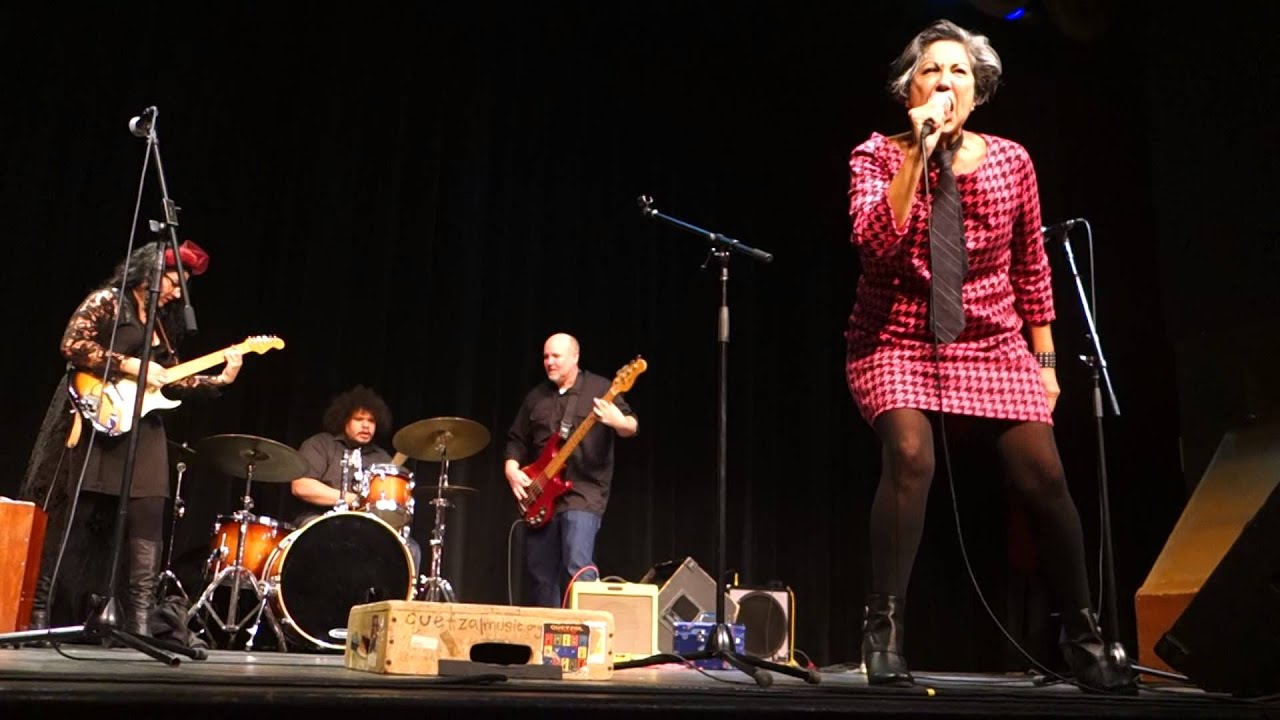


I see myself as limitless, so the labels are strictly to facilitate specific functions for a limited amount of time. When I first started performing, I remember looking out into the audience. Usually, there were lights near the front of the stage illuminating me and the other band members. As my gaze moved further back into the audience, the room darkened. I could make out the people in the front rows clearly enough to read their faces and feel their energy but beyond that, the room faded to infinite blackness and in my mind, that blackness might as well have been a view of the vast reaches of the universe. From my perch on the stage, I felt incredibly powerful as my performance elicited dancing, jumping and bursts of emotion from the concert goers. We were exchanging energy, refueling, tapping into something much bigger than any one person. I felt fully connected not just to the people in the room but to the entire universe.

Punk rock as religious experience; go ahead and laugh, I know it sounds crazy. Connecting with others on that level made me understand my power not just as an individual but as part of a community. So while it's important to know who we are, it's also important to know that we are so much more than labels can convey. We are conduits for ideas, we are agents of change.

Wednesday, October 17, 2012

The Network Awesome Interview (Excerpt)


NAmag: How did you get started in music?
Alicia Velasquez: Music has been a part of my life for as long as I can remember. My father's Mexican rancheras and my sister's soul music were the soundtrack of my childhood. In school, the music teacher Miss Yonkers noticed that I could sing and singled me out when she needed help. She assigned a portion of the class to follow me when teaching two-part harmony or when we sang in rounds. I was still in elementary school when I got my first job singing for bilingual cartoons, so I thought of myself as a singer from a very early age.
NAmag: Like probably a lot of people, I was introduced to your music when I saw The Decline of Western Civilization in the early 80s. Your music really stood out against the other bands in the film, being very iconoclastic and hard to pin down, at least for me, being a teenager growing up in Billings, Montana. What were your musical goals at the time? Do you have any specific memories regarding the film? I understand there are full-set recordings from the shoot-- is anyone trying to find/release them?
AV: The Bags' performance in The Decline of Western Civilization documents a time when the band itself was in decline. We were pulling in different directions and had just had a major falling out with founding member Patricia Morrison. It's no wonder that you have a hard time figuring out what we were going after, I think we were having the same issue. By the time the film was released, the band itself had broken up. I couldn't watch the Decline for many years because I didn't think it had captured the band at its best, but I'm over that now. I think despite the band's struggle, you can still see some of its good qualities and the film had a tremendously positive effect on many people. I ran into Penelope Spheeris a few years ago and she mentioned releasing a Decline DVD, possibly with additional footage but I haven't seen it.
NAmag: We are running a Bags performance from 1978 that is pretty fiery and aggressive-- do you remember this show specifically or why it was video taped? What was the general reaction to the band live? Were you supported in LA?
AV: This particular show is at The Troubadour in West Hollywood. It was the first time that the Troubadour, a club accustomed to hosting “soft rock” opened its doors to punk. Aside from that, the thing that sets this show apart is that it’s part of a bigger story which has come to be known as the “Trashing of the Troubadour.” It was during this show that my boyfriend (and our drummer at the time) got into a fight with the singer Tom Waits, who was in the audience. It’s a long story. The mayhem resulted in punk being banned from the Troubadour for a couple of years. It was a rough show but certainly not the rowdiest crowd or performance for the Bags. We had a reputation for wild shows and between us and the Germs, we probably had the most out of control audiences of the early punk scene. This particular show was videotaped for a student documentary about the LA punk scene. Clips from it surface from time to time but as far as I know, it has never been officially released.
I don't know if this answers your question. The Bags were very popular in L.A. We could play a club twice in one night and sell it out both times but aside from that we were all part of a growing yet intimate punk community. We all went to each other's shows and supported each other.
NAmag: Seeing as this is part of our "Women in Punk" week, what do you think the legacy of female artists from the first wave of punk is in 2011?
AV: You're having Women in Punk week? I think you need 52 of those!
The legacy of punk is not determined by gender. Any legacy that punk has left behind is as much due to women's contributions as it is to men's. The DIY ethic, the challenge to the status quo, the confidence to pick up an instrument, a paintbrush, a camera or any other tool that you have not been trained to use and to discover your power for yourself without feeling intimidated are all part of having a punk attitude. I see punk attitude in the women of Saudi Arabia who recently got in the driver’s seat of their cars to challenge that country’s restriction on women driving. I see the legacy of punk in hacker groups like Anonymous who target corrupt governments and corporations. The legacy of punk is not in its musical style, it’s having the audacity to actively participate in shaping our world.
NAmag: Indeed. The music industry has changed significantly in recent years, especially in terms of distribution-- do you see any emerging opportunities women should take advantage of? Do you think it is easier for young women to get started in music today?
AV: Yes, I do think it's easier in some ways but more difficult in others. It seems that anyone can produce a recording and sell it on the Internet but I think it's difficult to build an audience without first creating a community. A community is a powerful support system. Without it, an individual artist can get lost in a sea of talented individuals.
Excerpts from a 2011 interview, full interview published here: http://networkawesome.com/mag/article/an-interview-with-alice-bag/

Monday, January 30, 2012

13 Questions With Susana Sepulveda


An interview conducted by Susana Sepulveda, student at UCSC, January 2012.

1.) Do you identify as Chicana and if so, how do you feel you embody this identity in punk?

Alice: I do now, but I didn't always. When I was younger I wrongly believed that there was something I had to do, a test I had to pass or a class I had to take to be able to call myself a Chicana. I know better now.

I identify as a Chicana punk. Punk is an attitude, it's a rebellious, unapologetic dig at the status quo. As Chicanos we've had to fight to carve our way into a narrow and bigoted definition of what it means to be an American in the US while at the same time refusing to be blanched and synthesized by assimilating into the American mainstream. Refusal to relinquish our ethnic identity is punk.

2.) How do you feel you created a space for yourself in punk?

Alice: I showed up and played, I was at the right place at the right time. I was in tune with what was happening in the music scene and wanted to be at the forefront of it, so I put myself there. It meant moving to Hollywood which was where the punk scene in Los Angeles took off first.

3.) Was it difficult to be recognized in punk as a woman of color?

Alice: My ethnicity was acknowledged in a casual way, I never felt like anyone tried to diminish or disparage my background. I always felt completely comfortable in my own skin being a woman of color in the early L.A. Punk scene. In some ways, I had an easier time being a Chicana Weirdo around other weirdoes than I had being a Chicana weirdo around other Chicanos.

4.) Do you separate your racial identity from the scene, or do you feel that you perform and/or represent it? Would you say that is performed/represented in an alternative way (from what it is dominantly known or seen as)?

Alice: My racial identity is always with me, as is my gender, my background, everything I am is represented in the work I do. Sometimes it's overt, sometimes it's not and it's not even always deliberate but what we create can only come from what we have within.

I think there is a dominant way to represent Chicano identity and I have no problem with it as long as it doesn't become the exclusive way to do it. The growth and success of the Chicano movement depends on its ability to be inclusive and represent a broad spectrum of Chicanos.

5.) Do you feel that the emergence of more Chican@/Latin@ youth in the punk scene has maybe altered punk from the dominant idea of what it is? If so, what changes have you encountered or noticed? Would you say that it is a completely new scene of punk?

Alice: There were Chicanos present in the early LA. Punk scene. The Masque was a beautifully diverse club where people from all of L.A. County's communities felt at home. I guess what I'm trying to say is that Latinos have always been there. The punk scene is a landscape and the people who document it choose what they focus on. We need to do more documenting, more validating; if we're not seeing Latinos then we need to redirect the focus.

6.) How do you feel the punk scene has embraced feminist ideas, if any? And how these ideas might be transforming punk itself? Have feminist ideas always been a part of punk (just not visible)?

Alice: I think feminist ideas have always been a part of punk. Women helped create the punk scene as equal partners and in equal numbers to men. Women empowered themselves to do everything that men had traditionally done. That's not feminist theory - it's feminism in action. Feminism was there at punk's inception. Over the years as punk has evolved we've made gains and we've had setbacks but those of us who were permanently changed by punk will never allow women's contributions to punk to be overlooked or diminished.

7.) Do you feel that "Chicana Punk" or punk with feminist attributes is a completely different punk scene?

Alice: No way, I refuse to be a faction. I want in on the big action, punk without pussy power, punk without ethnic diversity just supports the status quo, it doesn't subvert or challenge it, therefore it can't even be called punk.

8.) Do you feel punk can be thought of as a space to evade and contest social violence? Do you feel it can recreate violence within itself? How so?

Alice: If by social violence you mean social injustice such as unfair laws and practices, I'd say yes. I think punk is more about confrontation than evasion. Punk is the perfect medium for contesting social violence because it's about questioning authority.

9.) How do you feel about discussions of punk being incorporated into academic discussions? Does it lose a certain aesthetic or authenticity?

Alice: Academic discussions are often based on having read the same texts and being familiar with the same theories as other people involved in the discussion. Discussions between people who have different points of reference can be productive if the participants take time to understand and respect each others' experiences.

10.) Do you consider yourself a feminist? Do you feel that you embody feminism or feminist values in performance, music, and/or punk? How so?

Alice: Yes, I consider myself a feminist. I never set out to embody feminism onstage but being a woman in a band, playing music with other women, being assertive and somewhat androgynous in my performances are all consistent with my feminist values.

11.) How do you feel you have rebelled against dominant values of Latin@ culture, if any?

Alice: I don't think I have rebelled against Latin@ culture. I have rebelled against those who try to make me warm tortillas for my brothers when they can warm them for themselves, I have rebelled against a patriarchal religion. I rebel against small mindedness in all ways and in every situation but those things are not an intrinsic part of latin@ culture and I will fight tooth and nail against anyone who tries to make me feel like I'm less Chican@ for not embracing the small-mindedness.

12.) Has embracing punk transformed your identity as a Chicana or women of color? Would you say that you have created a new culture and/or space for yourself (balancing punk and Mexicanidad), in your own way?

Alice: Yes, embracing punk and knowing that I was participating in its creation and definition made me feel that I had the power define my Chicana identity in my own way. Both chican@ and punk ideology have to do with being true to yourself and asserting yourself ethnically, artistically, spiritually, in all ways.

13.) Do you feel that punk itself is a culture?

Alice: Yes, I think so. I know that punk is much more than a style of music, it's a way of looking at the world, a way of looking at yourself and empowering yourself. Punk is great at destroying the illusion of limits. It starts with the feeling that you can express yourself onstage and make an impact on music and ends with the certainty that you can express yourself in any arena and make an impact on the world.

Monday, January 25, 2010

Freedom Isn't Free

"I'm not a hyphenated anything!" fumed my father-in-law. "I'm not a Mexican-American, I'm an American." The ardor with which he spoke these words made me wonder what was bringing on the sudden outburst. It surprised me, since my in-laws have for years taken a keen interest in their heritage which has revealed Mexican, Spanish and Apache ancestry. Maybe it had something to do with the t-shirt I noticed my father-in-law wearing a few days ago. It had the words "Freedom Is Not Free" written in small letters over his chest.

My father-in-law is a decorated Korean War veteran. He's an interesting man, smart, opinionated and with a dark side that he's managed to compartmentalize over time. Some of the most memorable conversations I've had with him concerned the nature of evil and questions of identity.

"Everyone's from somewhere," my mother-in-law chimes in.

"That's right, you don't hear of English-Americans or Greek-Americans," my suegro continues.

"I've heard of them," I'm tempted to say but decide that just this once I'll listen instead of talk.

Deep down, I already know what they're saying. Why do we qualify the word American with information about our heritage? Why don't I say I'm Vegetarian-American, or I'm Feminist-American? Those are bits of information about me that say something about who I am too. Hmmm, maybe he's got a point there.

What purpose does it serve to hyphenate our nationality? I don't know. I mean, doesn't it make it easier for people to make assumptions about us, perhaps even stereotype us? I recall an episode from my high school days when I was asked to paint a mural at school. I was excited at first and dreamed up a surreal image from my fevered imagination but I came crashing back to earth when I was told what I could paint - an Aztec pyramid with a eagle perched on a cactus in the foreground, something that would "be meaningful for the Mexican-American students." I couldn't figure it out. If anyone was Mexican-American, I certainly fit the bill but I didn't limit myself to the iconography of past generations.

I've been calling myself a Chicana for a many years now and before that I was Mexican-American, briefly Hispanic and for just a split second, Latina. When I lived in Los Angeles, if someone asked, I would say I was a Chicana and I felt pretty confident that the person knew what that meant, but maybe I was assuming too much.

Let me define my terms. I think of Chicanas/Chicanos as US born individuals who, although born and raised in the United States, retain an awareness of our Mexican heritage and find strength and hopefully wisdom in the balancing of our dual cultures, creating a powerful hybrid identity. People who define themselves as Chicana or Chicano oppose assimilating the values of the dominant culture and make a conscious decision to retain our duality and allow it to guide our personal and political decisions. Well, that's what it means to me anyway - I wouldn't mind if people assumed all those things about me when I say I'm a Chicana.

Here in Phoenix, it's different. First of all nobody ever asks, they're too darn polite, but there's also the fact that in Phoenix I have...let me see...one...two...make that zero Chicano friends. I don't know very much about my friends' cultural backgrounds, but with names like Wass, Forsythe, Budzak, Peters and Mar I have a feeling they're not Chicanas. I don't even know if they know that I'm Chicana or what one is (unless they're reading this right now) but it just doesn't seem to matter. To them I am the crafter, the (hyphenated) dog-walker, the mom. They relate to the part of me that gels with the part of them which we have in common.

So when does nationality matter? I suppose it matters most when you're fighting a war or defending whatever you see as patriotic values (Freedom Isn't Free). I think my father-in-law probably fights that war every single day of his life.

Sunday, May 27, 2007

The Others

I'm doing an email interview with a grad student who is working on her dissertation and she's asked me some thought provoking questions. Question #5 gave me a bit of trouble and I've decided to share it with you.

Question

If we consider woman and chicana as “other” within a white patriarchal society and punk as also projecting itself as a type of “other” in society (or a place for “others”—societal “rejects”/rejectors of all kinds), how do you feel your own understanding of yourself as “other” in this society was a force in your work as a punk artist? Can you give any specific examples of how this worked for you (particular lyrics, songs, things that happened at a gig, etc.)? [I’m familiar with what you have said about how punk allowed a certain space for anybody to play, etc. I’m mostly interested in how as an artist you may have taken “otherness” or some subjectivity that would “normally” be considered marginal, or even “abject” (such as women in rock, chicanas in rock, women in control, etc.) and made it a center.]

Answer

One of the challenges I have with explaining my role in the early punk scene to academics is the tendency to assume that I was rebelling against society because of being marginalized as a female or as a Chicana. I don’t think being an “other”- meaning a woman or a Chicana - had as much influence on my music as being caught in the middle of domestic violence and witnessing gang violence as a child. I’ve said it before, but I witnessed gang shootings on a regular basis both at school and in my neighborhood. Instead of finding a safe haven at home, it was even worse because the people that I loved most were in constant danger of being attacked. Those experiences have more to do with survival. If you think about Maslow’s Hierarchy of Needs, you’re not going to worry about defining yourself as a woman or a Chicana or part of any social movement when you’re just trying to stay alive and trying to make sure that those you love are not being killed or beaten. My motivations were much more basic and primal.


I didn’t think about being the “other” when I was on stage performing. Alice Bag was really defined by that little kid, helpless in the corner watching her mom being beaten up. Suddenly, I was powerful, strong and full of rage and it poured out of me, unrestrained. I’ve read that some people consider me an early “hardcore” performer, but that’s only because the emotions and anger I expressed on stage were real, not part of a stage act. Brendan Mullen recently wrote about my first performance at the Masque that he’d “never seen a woman so angry.” How much of that had to with being the “other,” I don’t know. Being a woman, being economically disadvantaged, being a Chicana were all ingredients mixed up in the explosive recipe that produced Alice Bag.

I was watching the Henry Rollins show today and I was struck by how much more intelligent and articulate he is than the average talk show host and it occurred to me that this was true of many of the early punks. I think that a lot of my punk peers were especially intelligent and/or creative individuals who may have seen themselves as “other”, but only in the sense that society did not “get them.” They were not suffering from any inferiority complexes. Rather, they were holding onto their sense of individuality and the things that made them special because they knew that they were right and society did not value their individuality. I think being “other” for us was like feeling that you had a magic wand but that you didn’t know how to use it. You knew you were different and special and the thing that set you apart from others also defined you and could be your source of power if you could figure out how to tap into it.

I guess I thought of myself as a misfit because I had been ostracized the whole time I was growing up. When punk came along, it was just the perfect vehicle for me to express who I was an individual. It was new enough and open enough to allow itself to be defined by people like me. Just a couple of years later, that would change and people would have to fit into preconceived notions of what punk rock was or wasn’t. The early scene had no such limitations because we were the ones creating and defining it. If you had been at the Masque in 1977, you would have seen very eclectic shows, ranging from the Screamers to Arthur J. and the Goldcups, from Geza X and the Mommymen to The Controllers. There was no clearly defined punk sound, no dress code and all you had to do was show up and make your presence known. The movement was one of individuals and individual expression, each of us bringing our heritage and formative experiences with us in an organic and in my case, unplanned way.

With regards to defining myself as a Chicana, I recall a previous interviewer asking me about bands such as Malo, Tierra, and other seventies Chicano rock bands and I replied that I remembered cruising and going to dances at Kennedy Hall in East LA and listening to the music which was being played on every car radio (and 8 track!) in East LA at that time. It was the soundtrack of my youth and whether I acknowledged it or not, it is logical to assume that it crept into my psyche. I don’t see my music as an extension or offshoot of the Chicano music scene but I suppose it could be argued that it is, simply because I am Chicana, but if I am to be included in this category, I demand that the limitations of the label “Chicano music” be expanded to include atypical Chicana experiences.


The Chicano movement of my youth had no use for Bowie and Elton John freaks like me. It was very clear that I was too weird for them. I would have liked to be part of Mecha and help define what it meant to be a Chicana but I don't think they wanted my input. So I did not define myself as Chicana for many years because that movement had in fact rejected me. It wasn't until much later that I decided that I would define IT and I would call myself a Chicana and they would just have to deal with it. But it seems that movement has grown up and is not so self-conscious and is more willing to embrace those of us with hitherto questionable lifestyles, ideas and attitudes.